





Originally published by our sister publication Pain Medicine News
Cryoablation of a nerve section that was damaged during a mastectomy reportedly can reduce associated pain, and could relieve the persistent pain in post-mastectomy pain syndrome (PMPS).
J. David Prologo, MD, an associate professor in the Department of Radiology at the Emory University School of Medicine, in Atlanta, and his colleagues described a successful trial in 14 patients with PMPS, who underwent percutaneous CT scan–guided cryoablation of the intercostobrachial nerve. Level of pain and the pain interference with function were assessed at 10, 90 and 180 days after the procedure.
The investigators reported statistically significant reductions in the participants’ Numerical Rating Scale of Pain Intensity scores, measured for occasions of “worst pain,” “least pain” and “average pain,” as well as in the total score from several scales of pain interference with function, including walking, normal work/activity and sleep. Other measures included the Patient Global Impression of Change scale.
The study was presented at the 2022 annual meeting of the Society of Interventional Radiology (SIR). It is estimated that PMPS affects 20% to 68% of patients who undergo a mastectomy (J Pain 2011;12[7]:725-746).
“There were no procedure-related complications or adverse events during follow-up,” the investigators reported, nor episodes of breakthrough pain during the 180 days. “Percutaneous CT-guided cryoablation of the intercostobrachial nerve may represent a new therapeutic option for patients with post-mastectomy pain syndrome,” they concluded.
Prologo discussed the approximately one-hour outpatient procedure. He indicated that candidates for cryoablation generally will have had persistent pain for at least six months after the surgery. “We want them to be healed and out of their postsurgical window,” he said.
Prologo noted that this investigation of cryoablation as a treatment for PMPS is novel, as it is commonly used to destroy solid tumors, including as an investigational alternative to lumpectomy. However, the procedure has been used for other nerve-based pain conditions, including phantom leg syndrome.
“The idea of applying cold to these nerves has been around for some time. What is different about our application is that we have advanced imaging guidance. So, what we do for a living as interventional radiologists is we guide needles into the body, in various places with exquisite precision,” Prologo said.
The team demonstrated that an appropriately targeted and timed cryoneurolysis of the pain-generating section of a nerve damaged in axillary dissection can provide both immediate and prolonged pain relief. Prologo expected, as has been his experience in treating pudendal neuralgia after childbirth, that the subsequent regeneration of normal nerve will not be a source of resumption or persistence of pain.
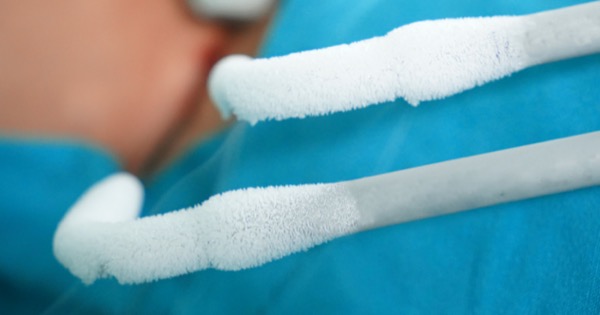
In this trial, participants received a CT scan–guided diagnostic nerve block with bupivacaine and betamethasone to confirm the pain-generating area. Participants who had at least a 50% reduction in pain from the nerve block were eligible for cryoablation. The targeted nerve section was frozen for a specific amount of time at a specific temperature, such that the nerve would respond by degenerating and then regenerating—a process that Prologo calls “percutaneously induced neuroregeneration.” This sequence may allow interventional radiologists to repair damaged nerves with new, regenerated nerves.
“These cryoablation devices that we’ve been using, they were built for the destruction of tumors and not necessarily tailored for application to nerves, but that’s what we’ve been using,” Prologo noted.
To address this shortcoming, Prologo is developing and using a “smarter” cryoprobe through his company, Focused Cryo, which was reported in his disclosure statement at the SIR meeting.
“In order to expose these nerves to the right temperature for the right amount of time, we’ve got to have a device that measures the temperature, measures the time, provides feedback, measures the effect on the nerve, and allows for control of the ice so that other non-target structures can be avoided,” Prologo said.
Procedural Intervention Preferred To Medical Therapy
The refinement of cryoablation for PMPS is quickening with advances in imaging guidance, and is welcome because traditional treatments are often inadequate. The use of opioid analgesics, in particular, can be counterproductive and inappropriate for chronic pain, and is increasingly restricted and discouraged, Prologo noted.
“There has been an explosion of interventional radiologists who are performing advanced interventional pain management procedures in the last five years, probably a 10-fold increase in the number of cases that have been done,” he said.
“Over the last 10 years—as we realize how many of these nerves we can reach with our advanced imaging guidance, how many problems we can solve and how many people are put at risk for excessive opioid use—we have accelerated our efforts to provide alternatives.”
Kari Colen, MD, a plastic and reconstructive surgeon at The Institute for Advanced Reconstruction, Plastic Surgery Center, in Shrewsbury, N.J., discussed the cryoablation study.
She indicated that the intervention appears to be “a good initial step” for PMPS, before surgical correction is deemed necessary. “While the sample of patients is small and the study has a short six-month follow-up, the results are promising.”
Colen suggested that more data, beyond those in the necessarily truncated meeting presentation, could be helpful to better evaluate the effectiveness of the intervention as a treatment for PMPS. In one example, “the (investigators) present statistically significant improvements in pain at 10, 90 and 180 [days] post-procedure; however, it is unclear if all patients reported improvement,” she said.
At the meeting, Prologo explained that his team had conducted the trial with 14 participants despite having been budgeted for 30, due to the difficulty that COVID-19 had imposed on recruitment. In addition, the study was a preliminary investigation “to evaluate the feasibility, safety and early efficacy,” the investigators said.
Colen supported such initiatives. “As post-mastectomy pain syndrome is extremely common following the treatment of breast cancer, it is essential that we continue to develop effective treatment options.”
—Kenneth Bender
Please log in to post a comment