






BOSTON—In a cost-conscious healthcare environment, saving money while maintaining excellent patient outcomes is a holy grail that many surgeons seek but few find. Now a Kaiser Permanente research team seems to have achieved that elusive combination by using a polymer locking ligation system during laparoscopic appendectomy.
The study found that use of the clip, Hem-o-Lok (Teleflex), in these procedures was not associated with increased morbidity, mortality or postoperative complications relative to standard care treatments but has the potential to save a significant amount of money in acute appendicitis.
“Personally, I’m very conscious about cost of care because it is continually escalating,” said Samir D. Johna, MD, MACM, a staff surgeon at Kaiser Permanente Fontana Medical Center, in Fontana, Calif. “Everybody uses stapler devices, but I began to wonder if there wasn’t a less expensive alternative, and one thing that drew my attention is the Hem-o-Lok.
“I know that some surgeons have been using it to secure renal veins and renal arteries, while others use it to secure the cystic duct during cholecystectomy,” he continued. “So, I thought why not use it with appendectomy?” In the current study, Dr. Johna and his co-investigators compared outcomes of laparoscopic appendectomy using Hem-o-Lok clips and standard linear endoscopic staplers.
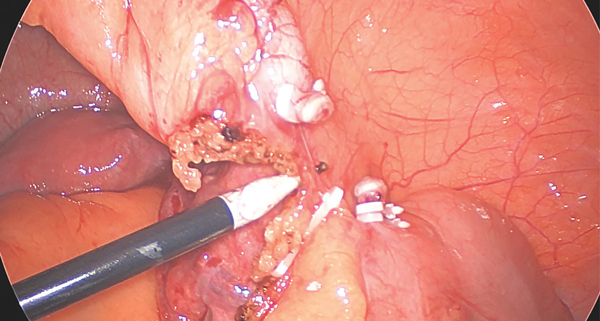
The team prospectively collected data on 340 patients presenting to the hospital between 2016 and 2022, in whom the clips were used to ligate the mesoappendix and base of the appendix. Next, the patients were propensity-matched (based on age, sex, body mass index and ASA physical status) with a group of 340 patients in whom the endoscopic stapler was used. The study’s primary outcome included 30-day postoperative complications, intraoperative events, hospital length of stay, operative time, estimated blood loss and hospital readmission.
In a presentation at the 2023 Clinical Congress of the American College of Surgeons, Dr. Johna said 2.1% of patients in the clip group experienced an intraoperative complication, compared with 2.9% of those who received the endoscopic stapler (P=0.457). Similarly, the two groups were also comparable on postoperative complication rate (7.1% vs. 9.4%, respectively; P=0.161) and readmission rate (6.0% vs. 9.1%, respectively; P=0.109).
Equally important is the potential cost savings that institutions can realize when using the locking ligation system.
“The Hem-o-Lok rack costs approximately $34, compared with $350 or $450 per case using the stapler,” Dr. Johna said in an interview with General Surgery News. “And in southern California alone, Kaiser performs [5,000] or 6,000 appendectomies annually. You can imagine the cost savings.”
As an additional benefit, Dr. Johna said the system is relatively easy to use. “It doesn’t have a steep learning curve. Some surgeons say the stapler is faster, which is true, by maybe a couple of minutes. But the difference in costs is huge.”
Despite the advantages, Dr. Johna was quick to recognize that the system may not be for everyone and would not be applicable in every clinical scenario.
“I’ve taught many of my partners how to use the Hem-o-Lok,” he said. “Granted, not everybody bought into the idea, but those who did loved it. And, of course, we don’t use it on every appendix. We understand there are certain circumstances that the clip may not be best. But even if you do 50% of the time, you’re still saving a lot of money.”
The investigators recommended that other clinicians consider using the system. “Surgery is both a science and an art,” Dr. Johna said. “And I think we have to be vigilant to cut costs without compromising quality.”
Joseph H. Ruan, MD, the assistant chief of general surgery at Kaiser Permanente in the San Bernardino County area, said the adoption of the locking ligation system makes good financial sense.
“All across the country, we’re all feeling the pinch from a money standpoint,” said Dr. Ruan, who was not involved with the study. “Everyone wants to do their part, and certainly surgeons have some responsibility to be effective in our use of tools and not waste too much.”
That said, Dr. Ruan said use of the clip system can alter the way he performs laparoscopic appendectomies.
“The clip requires the tissue to look normal for it to be used,” he explained. “While the clip is fairly big, there is a limit to how much tissue it can handle. If there’s a very large appendix base or if we have to take part of the cecum, then we can’t use it. But in all the patients that I’ve used the clip, I’ve not had any complications whatsoever.”
Yet for Dr. Ruan, one of the study’s most interesting insights is that sometimes innovation comes in the unlikeliest of forms. “Everyone talks about better technology, bigger instruments, more expensive things. But at the same time, to use something ‘old-fashioned’ in a new way is also an innovation. I think this study just shows we don’t have to always be using more advanced and more expensive things to give better care.”
Drs. Johna and Ruan reported no relevant financial disclosures.
This article is from the April 2024 print issue.
Please log in to post a comment
Endo loops offer a much less expensive alternative to staplers and do a wonderful job on the large appendiceal base.
The 15 mm hemolock clip is an excellent option and can also used to securely control the mesoappendix.
When US surgical in Norwalk started supplying stables for their “ stainless steel hardware , I could purchase each unite for $50.00 and I assume Saint Vincent’s hospital added an additional charge to the insurance charges.
why in the world couldn’t competition cause this outrageous cost of staples return the charge to a reasonable rate?
Robert E Sax meds 63
Nice work. Of note, this has been reported previously and a comparison between two clips on the patient side versus only one clip on the patient side showed no difference. The concern was creating a 'closed loop' stump. I believe using the hem o lock is common in other countries that can not afford a stapler. Endoloops is another option. You can also create your own endoloops with a knot pusher to be even more cost effective.