





The pendulum has swung too far toward nonoperative management of blunt liver injuries, resulting in preventable mortality and a loss of vital skills among surgeons, according to Andrew Peitzman, MD, who delivered the 2024 Scudder Oration on Trauma at the most recent Clinical Congress of the American College of Surgeons.
Dr. Peitzman, Distinguished Professor of Surgery and a professor emeritus at the University of Pittsburgh Medical Center, reviewed the evolution of liver trauma management from World War II through the present day, and challenged the field to collaborate with liver experts and revive lost skills in order to improve patient care.
The Scudder Oration is focused on the clinical management of surgical problems. It honors Charles Locke Scudder, MD, a founding member of the ACS and a renowned trauma surgeon. Dr. Peitzman said the topic of high-grade, blunt trauma liver injuries had been on his mind due to the recent accumulation of outcomes data at the University of Pittsburgh, and is an issue that has interested him throughout his decades-long career.
“What caught my attention in reviewing our data alongside papers published over the last 30 years was that as trauma surgeons, we’ve not improved; mortality remains unchanged at 50%,” he said. “We’ve done so well in moving the needle in so many areas, improving survivorship with so many other kinds of injuries. Why hasn’t that happened with high-grade liver injuries?”
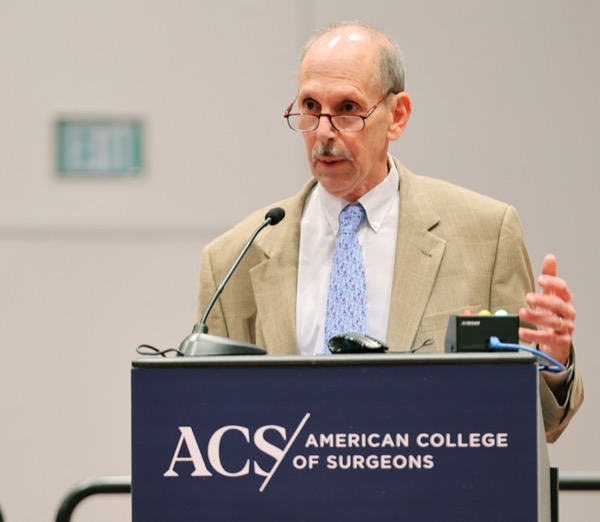
Dr. Peitzman attributed this stasis to three primary and interrelated factors: the rarity of these kinds of injuries; the introduction of CT and the promulgation of nonoperative management of blunt liver injury beginning in the early 1990s; and the atrophy of the skills needed to surgically manage these injuries.
“It’s a perfect storm of having an injury that’s extremely uncommon to begin with—even in the busiest of busy trauma centers, you rarely see more than five to eight of these cases in a year—combined with technology that’s decreased how often we turn to surgical management and the resulting loss of an already rare skill,” Dr. Peitzman noted. “It’s no one’s fault, but when we’re confronted with this rare and tremendously challenging injury, we’re really not ready to deal with it effectively.”
The way for the field to move forward, Dr. Peitzman said, is to “restock the tool box” by promoting training in critical surgical techniques and active collaboration between trauma surgeons and hepatic and hepatobiliary experts whenever possible.
“In centers where you have access to experts in hepatic surgery, whether liver transplant surgeons or hepatobiliary surgeons, they should be fully incorporated in the management of blunt liver injury patients,” he said. “It should not be on a sporadic basis where they’re called to the operating room in the rare event that one of these cases comes in. It really needs to be proactive and preemptive, with trauma surgeons and liver surgeons talking and developing a protocol. That’s action item number one.”
The second action item Dr. Peitzman identified, especially at centers where there are no experts in liver surgery on staff, is for all trauma surgeons to develop the basic skill set for achieving hemostasis. He noted that the ACS offers courses that teach the requisite skills.
“There are simple operative maneuvers that will control bleeding from liver injuries—at least temporarily—in about 85% of cases, so that a well-trained trauma surgeon should be able to get most operative cases off the table,” he said. “For the small number of cases that require a liver expert where none is available, those patients can be stabilized at the first hospital and then transferred to a center with more liver expertise.”
Dr. Peitzman has practiced what he preaches for 30 years at his center, he said, with encouraging results. A recent review of the outcome data revealed an all-cause operative mortality rate of grade IV and V liver injuries of 23.5%—substantially lower than figures generally published.
Jeffrey Kerby, MD, PhD, the chair of the ACS Committee on Trauma and director of the Division of Trauma and Acute Care Surgery at The University of Alabama at Birmingham Hospital, who introduced the Scudder Oration at the conference, praised Dr. Peitzman’s lecture as timely, relevant and actionable.
“I appreciated hearing a master surgeon like Dr. Peitzman share the lessons he’s learned with the larger trauma community, and I think he correctly outlined that over time, as the focus in blunt liver injury has shifted to nonoperative management, we’ve lost our skill set for operative management,” Dr. Kerby said. “We haven’t really seen any improvement in outcomes over the last 20 years, so certainly this is a call for action to lean into this issue.”
Dr. Kerby echoed Dr. Peitzman’s suggestions and added that with regard to the education component, incorporating more exposure to elective liver surgery into resident and fellowship training for trauma surgeons is another way to improve outcomes in the long term.
“We need to look at the training platforms we have and try to provide more exposure to elective liver surgery, so that when we see these blunt liver injuries that have such high mortality, we’ll be better prepared to handle them,” he said.
This article is from the June 2025 print issue.
Please log in to post a comment