





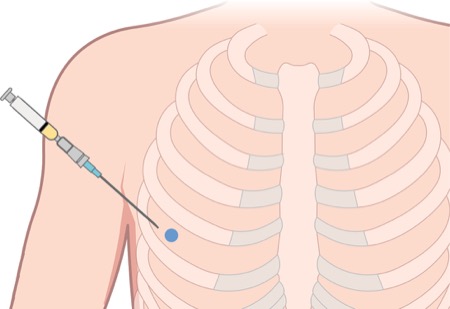
Performing needle thoracostomy for tension pneumothorax at the fourth to fifth intercostal space at the anterior axillary line results in higher rates of success and less risk for organ injury than the second intercostal space at the midclavicular line, according to a study presented at the 2025 Eastern Association for the Surgery of Trauma Annual Scientific Assembly.
The American College of Surgeons’ Advanced Trauma Life Support (ATLS) guidelines were updated in 2018, to recommend the fourth to fifth intercostal space at the anterior axillary line instead of the previously recommended second intercostal space at the midclavicular line.
To examine whether the following recommendations resulted in better outcomes, researchers at the University of Tennessee Medical Center, in Knoxville, conducted a retrospective study of adult patients 18 years of age or older who were involved in blunt or penetrating trauma, and had at least one attempt at needle decompression in the prehospital setting from Jan. 1, 2018 through March 11, 2024.
A total of 157 decompression attempts on 147 patients were included in the study. Among them, the fourth to fifth intercostal space at the anterior axillary line was significantly more successful at providing entry into the chest cavity than the previous site (88.5% vs. 46.1%). Additionally, the new site was associated with a lower risk for injury to internal organs (occurring in 11.5% of attempts), compared with 37.7% of attempts when using the second intercostal space at the midclavicular line.
“This study demonstrates that the change in ATLS guidelines regarding needle decompression location has led to both safer and more successful attempts at needle decompression, specifically in trauma patients in East Tennessee,” said Sydney R. Willhite, MD, a general surgery resident at the University of Tennessee Medical Center. “Therefore, we are continuing to ensure that prehospital providers are utilizing the fourth/fifth intercostal space at the anterior axillary line to improve patient outcomes.”
Dr. Willhite noted that the research raised a few questions that might be answered in future studies.
“There is further research about whether needle decompression is being overutilized in prehospital settings in patients without hard signs of tension pneumothorax,” she said. “Additionally, as our team performs finger thoracotomy instead of needle decompression in the trauma bay, we are interested in the safety and efficacy of this procedure as well.”
This article is from the June 2025 print issue.
Please log in to post a comment
4th - 5th intercostal space @ antrrior axillary line was the way I was taught 50 years ago. Not movement limiting and easy to walk around with like a small suitcase for underwater seal.
Anterior approach @ the mid-clavicuar was always painful & difficult to have pateints walk around with underwater seal.
WWW, MD.,CM., FACS, FRCSC