





ORLANDO, Fla.—New research has concluded that tranexamic acid (TXA) is overused in the prehospital setting in trauma patients, a phenomenon largely born of the fact that administration of the agent is not being limited to indications that have shown benefit in prior data.
As such, the researchers urged institutions and professional associations to revisit their guidelines to reflect the current need for TXA in this patient population.
“During my fellowship, I noticed that many of our EMS [emergency medical service] personnel were giving TXA to patients who didn’t actually have any data-driven indication for it,” said Alexandra Brito, MD, who was a fellow at Wake Forest University School of Medicine in Winston-Salem, N.C., when the study was performed. “They may have had suspected bleeding, but they weren’t hypotensive, they didn’t have massive hemorrhage and they didn’t have a noncompressible hemorrhage. So, this became a quality improvement project where we went back and pulled all the patients who had received TXA in the prehospital setting.”
As part of the study, Dr. Brito and her colleagues assessed patterns of TXA use by EMS agencies serving a large Level I trauma center. To do so, they queried the trauma registry at the institution for patients who received TXA in the course of their medical management. As part of this effort, the researchers examined patients’ physiologic state in the prehospital environment using EMS records, physiologic state on arrival to the hospital and interventions performed in both settings.
These data, the investigators explained, were then used to determine practice patterns, including the appropriateness of TXA administration. The researchers examined how many patients who received TXA had a systolic blood pressure of less than 90 mm Hg, which is a common inclusion criterion for many TXA trauma studies.
“We also used less than or equal to 75 mm Hg, which was the cutoff for mortality benefit in the CRASH-2 trial [Health Technol Assess 2013;17(10):1-79],” Dr. Brito said. “Finally, we examined a benchmark of less than or equal to 70 mm Hg, which was the cutoff for mortality benefit in the STAAMP trial [JAMA Surg 2020;156(1):11-20].”
The study included data from more than 20 separately managed EMS systems between 2016 and 2021, all of which administer TXA while transporting patients to the trauma center. In total, 1,089 patients received TXA. Of these, 406 (37.3%) saw their treatment initiated by EMS services.
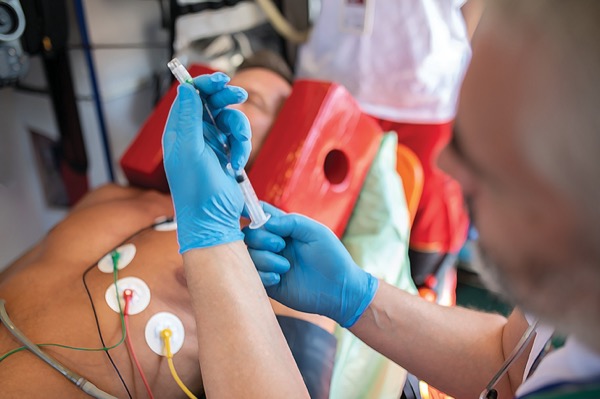
In a presentation at the 2023 annual meeting of the Eastern Association for the Surgery of Trauma (EAST; paper 34), Dr. Brito reported that the average prehospital systolic blood pressure among participants was 108.2 mm Hg, while their initial systolic blood pressure in the emergency department was 107.8 mm Hg.
“We found that very, very few people achieved compliance with standard indications,” Dr. Brito said in an interview.
Indeed, only 29.6% of patients who received TXA had a mean systolic blood pressure of less than 90 mm Hg, which the researchers consider common practice. Furthermore, only 14.6% of patients who received TXA had a mean systolic blood pressure of no more than 75 mm Hg, while only 11.9% of individuals receiving TXA had a mean systolic blood pressure of no more than 70 mm Hg.
“Less than 15% of patients received TXA for an actual data-driven indication for use of the drug,” Dr. Brito said. “So, what we found is that we’re seriously overusing TXA.”
And while many clinicians and EMS providers may believe that there is little, if any, harm associated with the liberal use of TXA, Dr. Brito has a different opinion.
“People think TXA is relatively safe,” she noted, “but there are actually quite a few potential complications associated with its use. Therefore, it doesn’t really make sense to expose people to potential risks, even if they’re relatively small.
“There has never been any evidence of benefit among patients who have hemorrhage with a systolic blood pressure greater than 75,” Dr. Brito continued. “So, if there’s no potential for benefit and some potential for harm, why give it?”
In light of these findings, the researchers have initiated the process of changing prehospital TXA administration criteria for trauma patients, although the process is complex.
“Getting consensus in the hospital environment in a situation where the data are muddy is very tricky, because everybody has different interpretations of the data,” Dr. Brito said. “I know the EAST guidelines for TXA use have been in the revision process for almost three years and still haven’t been released yet.
“TXA is a really cheap drug, easy to carry, has no special handling requirements and is thought to be very safe,” she added. “But when it comes down to it, we still don’t really understand the drug very well.”
As Steven Frank, MD, discussed, overtreatment with TXA is not particularly surprising, if only because it is human nature to give more of any treatment that may prove helpful to patients.
“It often takes more experience and judgment to know when to not give a treatment,” said Dr. Frank, a professor of anesthesiology and critical care medicine, and the director of the Johns Hopkins Health System Blood Management Program and Center for Bloodless Medicine and Surgery at Johns Hopkins Medicine, in Baltimore. “Furthermore, both the STAAMP and CRASH-2 trials had inclusion criteria which also considered heart rate (>110 bpm [beats per minute]), and not just blood pressure; this alone may have falsely increased the determination of overuse in this study.
“It is true, however, that patients with the lowest systolic blood pressures (<70-75 mm Hg) benefited most in both of these studies, and that thrombotic events were not increased by TXA,” Dr. Frank continued. “This suggests more benefit than risk with TXA, which likely explains the overuse.”
Dr. Brito is currently an attending trauma, critical care and acute care surgeon at the Queen’s Medical Center, in Honolulu. She and Frank reported no relevant financial disclosures.
Pancreatic Insufficiency During the American Revolution: An Eyewitness Account

Being a lyrical description of a young medical school graduate’s first night on call on the surgical service.
How does the new physician reconcile the thorough diagnostic process with an overwhelming workload?
The battle between the practical and the theoretical plays out at the bedside and ultimately in the chairman’s office.
A Declaration of Surgical Independence results.
A profession dies when its last court jester is silenced.
TheAmericanBardofSurgery@gmail.com

This article is from the August 2023 print issue.
Please log in to post a comment