





TAMPA, Fla.—The odds of presenting with metastatic or T4 colon cancer, having delayed surgical intervention and having worse mortality increased directly and linearly with distance to treatment facilities, according to new research.
Colon cancer outcomes in the United States have improved over the past 30 years due to an emphasis on screening and improved treatments, according to investigator Andrew Russ, MD, an associate professor of surgery at the University of Tennessee Medical Center, in Knoxville. But specific regions of the United States, such as the rural Southeast, have worse outcomes.
Dr. Russ and his co-investigators gathered data from patients with colon cancer from the National Cancer Database for 2013 to 2017. They analyzed outcomes including metastatic disease at diagnosis, T stage at diagnosis and time from diagnosis to chemotherapy initiation. The study cohort included 326,176 patients diagnosed with colon cancer in the South Atlantic (Delaware, Maryland, Virginia, West Virginia, North Carolina, South Carolina, Georgia, Florida and the District of Columbia) and East South Central (Alabama, Kentucky, Mississippi and Tennessee) regions of the United States.
Presenting the findings at the 2022 annual meeting of the American Society of Colon and Rectal Surgeons, Dr. Russ reported that increased distance from a treating facility was associated with:

- a statistically significant increase in the risk for presenting with advanced TNM stage (Table 1);
- a statistically significant increase in time to surgical intervention (Table 2);
- an increase in time to beginning adjuvant chemotherapy in the group 101 to 200 miles away (12.168; P=0.017; standard error, 5.12); and
- a statistically significant increased risk for mortality (Table 3).
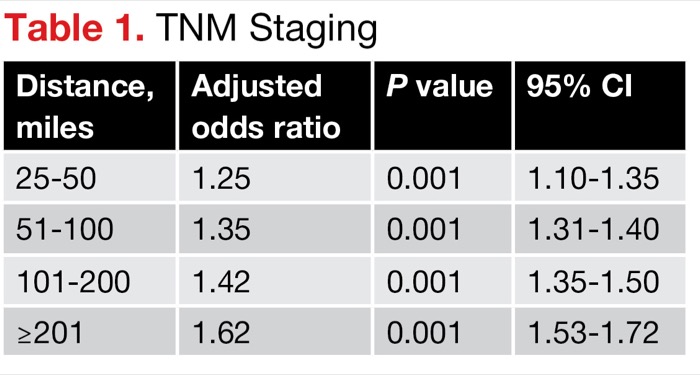
| Table 1. TNM Staging | |||
| Distance, miles | Adjusted odds ratio | P value | 95% CI |
|---|---|---|---|
| 25-50 | 1.25 | 0.001 | 1.10-1.35 |
| 51-100 | 1.35 | 0.001 | 1.31-1.40 |
| 101-200 | 1.42 | 0.001 | 1.35-1.50 |
| =201 | 1.62 | 0.001 | 1.53-1.72 |
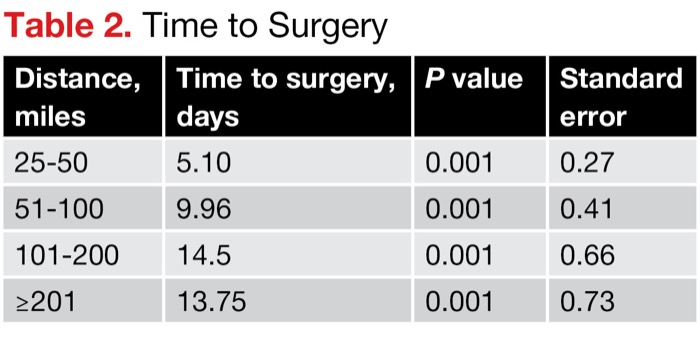
| Table 2. Time to Surgery | |||
| Distance, miles | Time to surgery, days | P value | Standard error |
|---|---|---|---|
| 25-50 | 5.10 | 0.001 | 0.27 |
| 51-100 | 9.96 | 0.001 | 0.41 |
| 101-200 | 14.5 | 0.001 | 0.66 |
| =201 | 13.75 | 0.001 | 0.73 |
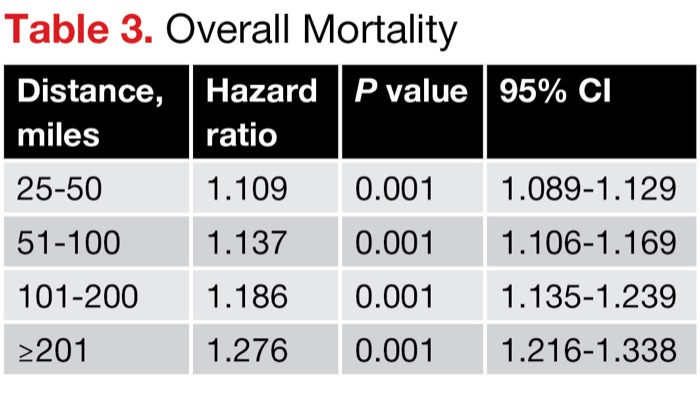
| Table 3. Overall Mortality | |||
| Distance, miles | Hazard ratio | P value | 95% CI |
|---|---|---|---|
| 25-50 | 1.109 | 0.001 | 1.089-1.129 |
| 51-100 | 1.137 | 0.001 | 1.106-1.169 |
| 101-200 | 1.186 | 0.001 | 1.135-1.239 |
| =201 | 1.276 | 0.001 | 1.216-1.338 |
The median survival was 82.4 months for the closest group (zero to 24 miles), versus 75.1 months for the farthest group (=201 days).
“Increased distance from a treating facility is an independent risk factor for presentation with later stages of colon cancer,” Dr. Russ said. “Time to surgery and time to adjuvant chemotherapy are increased as distance from a treating facility is increased. Patients have a stepwise decrease in overall survival as distance from treating facility increases. Efforts should be made to provide increased screening efforts and additional screening options to patients who have limited access to care.”
Data Apply to Large Portion of the U.S.
A large portion of the U.S. population resides in the regions covered in the study, so the authors are to be congratulated on looking for ways to improve the quality of cancer care delivered there, commented Deborah Keller, MS, MD, a clinical assistant professor at the UC Davis Medical Center, in Sacramento, who was not involved with the research.
“This study is interesting in showing evidence to support trends that we see clinically. The association between greater distance and more advanced disease at presentation is an important start,” Dr. Keller said. “However, there are a lot of limitations in the data source that restrict our ability to conclude that distance alone is the reason for later presentations in these regions or that these patients did not have access to care. I look forward to the full manuscript for the covariates considered. Also, evaluating recent data where telemedicine is more widespread and looking at that variable within this relationship will help [clinicians] make valuable insights from this abstract.”
—Kate O’Rourke
Please log in to post a comment