





AUSTIN, Texas—Patients who undergo nonelective ventral hernia repair tend to have higher recurrence rates, more readmissions and more complications. They also account for disproportionately higher expenditure than patients who undergo elective repair, further challenging the “watch-and-wait” paradigm, according to new research.
“Back in 2006, a now landmark prospective study suggested asymptomatic ventral hernias might be better observed than operated on. But in the literature emerged a number of worsening outcomes associated with nonelective repairs,” said 1st Lt. Theodore Habarth-Morales, a medical student at Thomas Jefferson University, research fellow in the Division of Plastic Surgery at the University of Pennsylvania, both in Philadelphia, and medical officer in the U.S. Army.
There are many unknowns around emergent ventral hernia repair (VHR) in the United States—not only how many are done but also the cost and outcomes. With a hypothesis that nonelective VHRs are prevalent and associated with a fair amount of morbidity and financial strain on the healthcare system, 1st Lt. Habarth and his colleagues designed a retrospective cohort study using the Healthcare Costs and Utilization Project’s nationwide readmission database to identify all patients who underwent VHRs, stratifying them by elective and nonelective procedures.
Their outcomes of interest were six-month recurrence, complications, unplanned readmissions, reoperations and costs. The study included 645,002 VHRs performed over a 10-year period in a patient population of 58% women with a median age of 59 years. About half of the patients were publicly insured, half were in the bottom half of income percentiles, most had two or more comorbidities, 29% were smokers, and 52% presented with obstruction or gangrene. The majority (78%) received open repairs, about half of the repairs involved mesh and 6% had a bowel resection at the time of the repair.
A sizable minority (45%) were classified as nonelective repairs. These patients tended to be younger, male, less financially secure and more often publicly insured with an average of 2.6 comorbidities. Fully 76% of nonelective cases presented through emergency departments compared with 1.3% of elective repairs. About half of nonelective repair patients presented with some type of obstruction; 19% underwent minimally invasive surgery compared with 24% of elective repair patients; and 62% of nonelective operations involved mesh compared with 41% of elective repairs.
At 180 days, VHR was 3.2% in the nonelective cohort and 2.7% in the elective repair cohort. Unplanned readmissions accounted for 2.4% of nonelective repair patients and 1.4% of elective repair conditions. Postoperative complications were seen in 33.5% and 25% in nonelective and elective repair patients, respectively. “All of these achieved statistical significance [P=0.001],” 1st Lt. Habarth said.
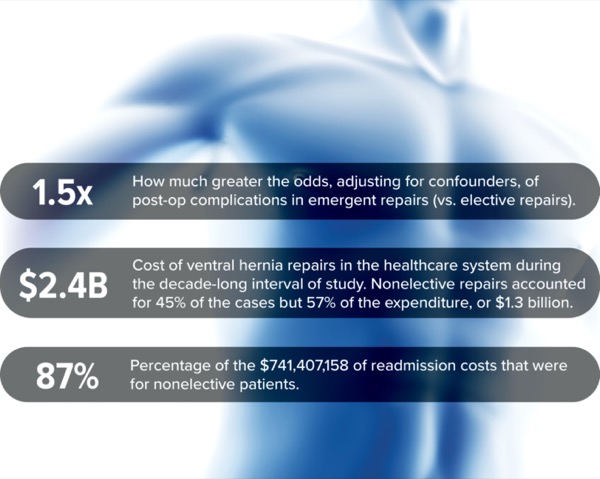
Adjusting for confounders such as comorbidities, tobacco use, hospital type, operative approach, bowel resection and other factors, they found 1.5 greater odds of postoperative complications in emergent repairs as well as higher odds of unplanned admissions and hernia recurrence.
“The really interesting result here was cost,” 1st Lt. Habarth said. Overall, VHR cost the healthcare system $2.4 billion during that decade-long interval. But nonelective hernia repairs, despite their lower proportion of 45%, accounted for 57% of that expenditure, costing $1.3 billion. “Even more interesting, 87% of the $741,407,158 of readmission costs were for readmissions of patients treated nonelectively. That’s a huge percentage and quite a large number to wrap your head around,” he added.
Looking at risk-adjusted costs, they found index admissions were about $1,000 more expensive and readmissions about $3,200 more expensive for nonelective surgeries than for patients who underwent elective repairs.
The study’s findings suggest nonelective VHR is associated with poorer short-term outcomes and pose a significant financial burden to the healthcare system, 1st Lt. Habarth concluded. “In the future, I think it would be worthwhile to look at risk stratification: to predict when a hernia will occur after a primary procedure and also to predict which hernia will present to the ED [emergency department] requiring a repair.”
Clayton Petro, MD, an assistant professor of surgery at Lerner College of Medicine, Cleveland Clinic Center for Abdominal Core Health, Ohio, told General Surgery News that 1st Lt. Habarth and his colleagues point out the consequences to making patients wait for their operation.
“I think we have become obsessed with optimizing patients, but it’s important to recognize that these patients with high rates of comorbidities are often the same patients who have the least access to medical care. Putting those patients at risk of needing a nonelective repair is disproportionately putting them behind the eight ball,” he said.
It is true these comorbidities raise the rate of a complication, but it’s important to keep some perspective on the scale of those risks, Dr. Petro said. “What is the actual risk of an SSI [surgical site infection]? If we say it doubles, that can sound intimidating to a patient. But that could also hypothetically mean going from 1.5% to 3%. Is it worth withholding an operation because of a 1.5% increase in risk? Those numbers are hypothetical but an example of how, in these conversations about comorbidity management, we can easily be disingenuous about the true risk of these comorbidities. In my opinion, the pendulum has swung too far toward trying to get every patient optimized.”
Dr. Petro acknowledged that the trend toward optimizing patients came from good intentions, not just trying to increase the chance of favorable postsurgical outcomes but also helping patients make lifelong changes that will benefit their health well beyond getting their hernia repaired.
“For the patients who make those changes, that’s great. But for the majority of those who don’t, you’re just keeping them in a situation where they may wind up in an emergency department in the middle of the night,” he said.
This article is from the February 2024 print issue.
Please log in to post a comment