





Introducing her talk on parastomal repairs during a session on particularly problematic hernias at the 2025 annual meeting of the American Hernia Society, Heidi J. Miller, MD, MPH, said she had no disclosures, and that she also had no answers.
“I was hoping to find gold in the literature, and sadly, it wasn’t there,” said Dr. Miller, an associate professor of surgery and associate program director with Maine Health/Tufts University, in Portland.
Surgeons struggle with parastomal hernias because they start with a loss. “We make a stoma; we make a hernia. That’s what I tell my patients, and when we start with a hernia, I can’t make it go away unless I can reverse it, so we’re kind of in a losing game.”
Also, patients who have a reason to have a permanent stoma tend to be complicated, with comorbidities, histories of multiple surgeries, and a high risk for recurrences and complications. “The morbidity that we can provide these patients, if that’s the way to say that, is really significant: mesh erosions, stoma retractions, long hospital stays, and a lot of time lost from their lives, a lot of reoperations, all in the setting of very insufficient data,” Dr. Miller said.
Even guidelines from the European Hernia Society, which puts together robust manuscripts, have few strong recommendations or high-level evidence to guide surgeons in managing parastomal hernias (Hernia 2018;22:193-198). “The most important takeaways are to use prophylactic mesh when you’re making an end colostomy. This is something we may not do enough, but there’s good data that it prevents the size of the os from expanding over time and is the best thing we can do to try and prevent these,” she said.
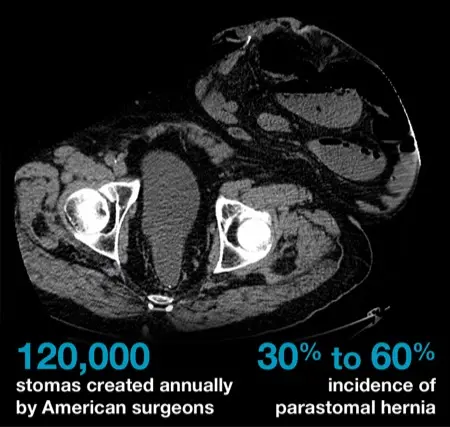
The problem of parastomal hernias is not inconsequential. American surgeons create more than 120,000 stomas annually, with an incidence of parastomal hernia of 30% to 60%. “And we think, well, we can just reverse them; the best hernia repair is getting rid of that stoma, which is a hernia,” Dr. Miller said.
But, only about half of those stomas get reversed, even when those hernias do get repaired the recurrence rates are up to 75%, and about one-third of those patients will return for additional surgery. The recurrence rate grows with each subsequent repair. After the second or third recurrence, there’s a near 0% hernia-free survival rate.
Surgeons in the United States might be able to take some comfort in not being alone. Even in Denmark, with standardized, centralized care and relatively healthy patients, the recurrence rate is 18%. At high-volume centers in the United States, recurrence rates hover around 20%.
“We still need to fix them, so how do we keep our enthusiasm? A lot of it comes down to the satisfaction of helping patients.” But in the setting of likely failure, how do you do better, or fail better? Largely, it’s a matter of establishing a growth mindset: Be willing to experiment and to learn from results, she said.
In “Right Kind of Wrong: The Science of Failing Well,” author Amy Edmondson identifies four factors that characterize intelligent failure. Dr. Miller suggested a surgeon’s take on those four factors:
- Try something new. “Whether you’re putting mesh in a new location, trying a new technique, or using a different suture—continue innovating.”
- Work toward a valued goal. “Talk with your patients and try to figure out the outcome you’re both searching for.”
- Build on the previous experience of your own case log, “as well as everyone you can find who will share these cases.”
- “Do as little damage as possible.”
Failing well in parastomal hernia repair requires acquiring a range of approaches and striving to innovate. “Mesh suture, whether it’s a funnel mesh, whether it’s a modified Sugarbaker, we need to continue to expand our arsenal because this is not a problem that’s going away.”
Surgeons should also follow their patients and share outcomes—whether online, at conferences, in manuscripts—as case reports or larger studies. “We need to continue monitoring this and not hiding it,” Dr. Miller said.
Shared decision-making also is essential, “working with the patient to reach an outcome where they’ve had some improvement, and I don’t feel like I’ve failed.”
Colston Edgerton, MD, a bariatric surgeon with Novant Health in Wilmington, North Carolina, told General Surgery News that patient optimization is particularly important in the setting of parastomal hernias.
“Smoking cessation, glycemic control, and weight management become even more critical when recurrence rates are higher from the start. Furthermore, options for metabolic surgery may be limited given complex surgical histories for many patients with stomas,” he said.
Achieving optimal outcomes can be a high-resource endeavor, requiring a multidisciplinary approach with team members who can assist with anti-obesity medications and smoking cessation, as well as consistent follow-up to monitor patient readiness for elective repair.
“Taking the time to discuss unique goals which may focus on improvement in pain, or relief of intermittent mechanical obstructions rather than the discrete outcome of hernia recurrence, is also critical prior to embarking on these complex repairs. For many patients who have been told few options exist for a better quality of life, building such pathways and utilizing a shared decision model may make these goals achievable,” Dr. Edgerton said.
This article is from the February 2026 print issue.
Please log in to post a comment