





Achieving success with anterior fascial closure is a multifaceted process that combines preoperative decision-making, intraoperative know-how and a sound exit strategy, according to John G. Linn, MD, the vice chair and chief of surgery at Endeavor Health, in Chicago. In a presentation at the 2025 annual meeting of the Society of American Gastrointestinal and Endoscopic Surgeons, Dr. Linn discussed his algorithm to achieve successful closure of the anterior fascia.
“To me, success in fascial closure begins with the decision-making process, which starts well before I operate on somebody,” he said. As part of this process, Dr. Linn asks himself a series of questions, two of which are most important: Does it matter if I can close this patient’s fascia? Do I have everything that’s going to allow me to do that?
Fortunately, several tools can help surgeons predict their ability to successfully close the fascia, both with and without component separation. The rectus-to-defect ratio is one such tool, where ratios less than 2 indicate individuals who are more likely to need component separation, while those greater than 2 indicate lower odds of the procedure. Intraabdominal fat distribution has also been shown to play a role, with greater anterior-posterior diameter indicating an increased chance of requiring component separation (Hernia 2023;27[2]:273-279). Finally, Tanaka scoring considers the ratio of the hernia sac to the abdominal volume: Sacs with volumes of 25% are more likely to indicate difficult fascial closure (Hernia 2010;14[1]:63-69).
Of course, the choice of surgical approach also plays a role in success, although the open versus minimally invasive debate continues. “If you show three hernia surgeons a CT scan, you’ll get three differences of opinion regarding approach for something that’s not a very large defect but has a very large amount of hernia sac contents,” Dr. Linn explained. Nevertheless, he said minimally invasive surgery may offer some benefit here.
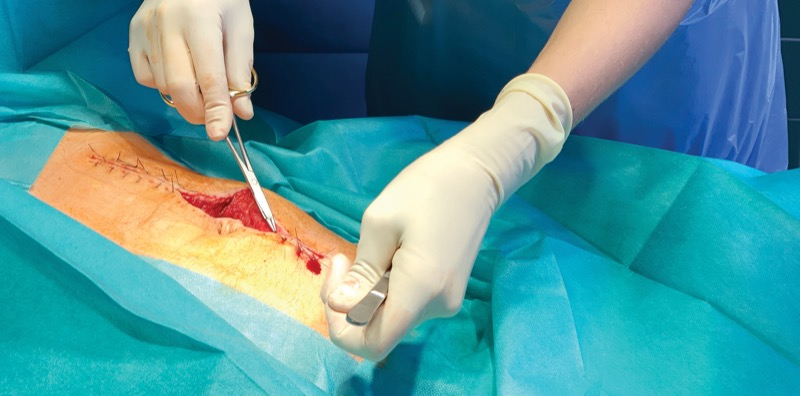
In the second half of his presentation, Dr. Linn discussed his algorithm for fascial closure, a framework that begins with transversus abdominis release (TAR), if necessary. Assuming the posterior layer is closed and the anterior fascial gap is approximately 5 cm, the first thing he does is perform a lateral dissection.
“That doesn’t make the fascia move, but if I’m going to end up in a bridging closure or a tension-heavy closure, I will extend the mesh further laterally to avoid some longer-term challenges,” he noted. For anterior fascial gaps of less than 5 cm, Dr. Linn performs transcutaneous fixation.
“But there’s consequences to that approach,” he added. “If we fixate mesh in a different way, we’re going to change its functional properties, and we may lead to mesh fractures from over-fixation.”
With respect to external oblique release, Dr. Linn’s algorithm assumes the external oblique muscle/aponeurosis has been separated from the internal oblique muscle, but an anterior fascial gap remains. “The location within the abdominal wall is important,” he explained.
In the lower third of the abdomen, dividing the inguinal ligament is an option, although Dr. Linn urged caution with the approach and recommended reinforcement of the preperitoneal space with mesh. In the upper abdomen, dissection above the costal margin is recommended, but there is the potential for challenges with the serratus and latissimus muscles. He also tends to favor preperitoneal mesh placement rather than retrorectus placement in these circumstances, to allow for further lateral mesh coverage.
Some clinicians consider the possibility of combining TAR with external oblique release, although Dr. Linn pointed out he’s never performed the procedure in a single stage. “I think you’re asking a lot of that very thin internal oblique for lateral integrity,” he noted. “I would just say proceed with caution, and I would probably choose a different strategy than this.”
If the fascia still cannot be closed, Dr. Linn considers bridging mesh a reasonable option, although the approach is not without potential drawbacks: Bridging mesh may look and feel like a diastasis, and repetitive loading can lead to mesh fracture. At any rate, clinicians who employ bridging mesh should first consider their objective, which is different than in primary fascial closure. “That mesh has to last,” he explained.
For this reason, he avoids absorbable materials in bridging situations. Mesh weight is another consideration, where Dr. Linn said heavyweight mesh is not as problematic as originally thought. He also recommended against use of lightweight polypropylene mesh and polyester mesh in bridging situations, both of which are subject to fracture in fascial closure.
As Dr. Linn concluded, achieving durable anterior fascial closure depends less on any one technique and more on a structured, patient-specific approach that integrates preoperative planning, intraoperative adaptability and thoughtful material selection.
For Vahagn C. Nikolian, MD, an assistant professor of surgery at Oregon Health & Science University, in Portland, achieving durable anterior fascial closure is fundamentally a tension-management problem, one that demands balancing tissue reapproximation with the mechanical forces that tend to pull the fascia apart.
“Over the past decade, we’ve seen an explosion of techniques designed to reduce that tension, from component separation to progressive preoperative pneumoperitoneum and Botox [onabotulinumtoxinA, Allergan],” he commented. “Yet despite technical innovations, the challenge remains: How do we close the fascia in a way that preserves function, minimizes recurrence and reduces morbidity?”
Perhaps this is why Dr. Nikolian’s approach has evolved as his understanding of abdominal wall anatomy and the chronic, progressive nature of hernia disease has deepened. Indeed, he now prioritizes achieving closure in the least destructive way possible and by preserving muscular and fascial integrity whenever possible.
“While adjuncts such as preoperative Botox, fascial traction and pneumoperitoneum have helped many surgeons improve their closure rates, I’ve focused more on careful patient selection and minimizing dissection,” he said. “Although transversus abdominis release remains a valuable option, I’ve found myself relying on it less frequently. Interestingly, as my TAR rate has declined, my rate of successful anterior fascial closure has increased, reflecting a broader trend back toward less invasive, preperitoneal-based repairs in appropriate cases.”
Drs. Linn and Nikolian reported no relevant financial disclosures.
This article is from the October 2025 print issue.
Please log in to post a comment