





In recent years, the literature on colon trauma surgery has moved toward performing fewer ostomies. While that’s generally a positive development, the pendulum may be swinging too far, according to a presentation at the 2024 Clinical Congress of the American College of Surgeons (ACS).
Timothy Plackett, DO, MPH, an associate professor of surgery at the University of Chicago, presented two contrasting cases along with recent literature, arguing that current recommendations can stop surgeons from performing ostomies when they are truly necessary. In both cases, Dr. Plackett deviated from guideline recommendations. In the first case, he said, that turned out to be the correct choice, but in the second, the wrong one.
Case 1
In the first case, a 22-year-old man with a gunshot wound in the abdomen arrived having already undergone an exploratory celiotomy, with parts of his small bowel and descending colon resected and left in discontinuity—and, significantly, with a left iliac artery injury. The patient was undergoing resuscitation efforts on arrival and had elevated lactate levels. When his condition stabilized and lactate levels decreased, he was taken to the OR, where surgeons repaired the damaged artery and reconnected the small bowel with a stapled anastomosis. Finally, they performed an end colostomy, diverting stool from the colon to a stoma on the abdomen.
Dr. Plackett noted that the current literature would have recommended against the end colostomy. He cited a recent study by Dilday et al that analyzed data from 1,244 patients in the ACS Trauma Quality Improvement Program (TQIP) database who underwent colon resection, to compare outcomes between patients who were given ostomies and those who only received a primary repair anastomosis. The patients were 3:1 propensity-matched on a variety of factors, including comorbidities, relevant injury scores and transfusions (Am J Surg 2024;228:237-241).
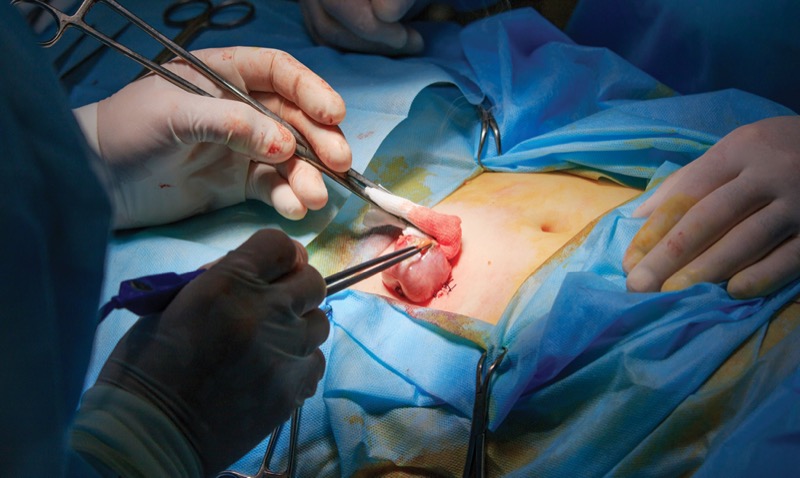
The study found no significant differences in unplanned return to the OR, surgical site infection incidence or mortality, and concluded that ostomies are not necessary in most cases, including a case like the one Dr. Plackett described. However, the propensity matching failed to capture important nuances for surgeons deciding whether to perform an ostomy, he noted.
“Transfusion numbers alone aren’t enough,” he said. “I’d rather know, how is this resuscitation going? If this patient’s lactate is not clearing, if their pH is not improving, if their potassium is going up, if you’re having to intermittently get bumps of vasopressors, if they’re on a drip—I’m not putting that together, at least not right away.”
Another factor that wasn’t captured in the TQIP data was whether the injury was on the left side of the colon. In that case, Dr. Plackett noted, there are two watershed areas that, if not properly accounted for, can result in ischemia. He also cited the presence of concomitant pancreatic injury and the patient’s ability to tolerate a leak as decisive factors.
Case 2
The second case involved a 45-year-old man with a gunshot wound, whose treatment was complicated by the presence of a bladder injury. Dr. Plackett and his team initially followed guideline recommendations and performed a loop sigmoid colostomy, but the patient worsened due to complications from the bladder injury. They then performed a low anterior resection, which made things worse, and they ultimately had to convert to an end sigmoid colostomy.
“The [American Association for the Surgery of Trauma] guidelines would have recommended just diverting this patient, which is what happened during his first surgery. Instead, I made the decision to go back to the operating room and cut out that part of the rectum, in part because the injury had gone through the bladder,” Dr. Plackett said. “My thinking at the time was that if we could completely take the rectal injury out of the equation, then he would only need to heal from the bladder injury. We thought we were being smart, but in the end, we just complicated the patient’s problems further.”
Dr. Plackett said more studies are needed—particularly prospective randomized controlled trials—that control for the relevant variables to further refine existing guidelines and recommendations.
Peter Kim, MD, an editorial board member General Surgery News from Pelham, N.Y., said Dr. Plackett’s presentation highlights the disconnect between real-life cases and academic studies, and that he’s hopeful that artificial intelligence tools will evolve in the coming years to assist overworked trauma surgeons with intraoperative decision-making, supplementing the role of mentors and consultants in this regard.
“We’re seeing some promising research in this area,” Dr. Kim said. “I’m optimistic that AI tools will really help us with clinical decision-making in the near future.”
This article is from the March 2025 print issue.
Please log in to post a comment
The vast majority of patients never need an ostomy. If u cant hook em up at first Staple off the ends after removing the offending lesion (perfed tics etc) wash em out leave 2 big drains in the gutters and close the skin. Bring em back in a week and anastamose .You'd be surprised how clean the abdomen is in a week. Patients thank u for "no bag" ....colostomy has been way over emphasized in the past.
R mark hoyle md
Dallas texas