





Hospital-related resistant infections and deaths increased at least 15% during the first year of the COVID-19 pandemic, pushing back the progress made in the fight against antimicrobial resistance (AMR), according to a new report by the CDC.
“This report confirms what previous research has suggested: COVID-19 has not only increased the threat of antibiotic resistance; it has undone years of progress, and on a staggering scale,” said David Hyun, the director, The Pew Charitable Trusts Antibiotic Resistance Project.
“The magnitude of the damage is significant. There are steps we must take immediately to protect people and save lives, including strengthening systems to improve the way antibiotics are used, and enacting policies like the PASTEUR [Pioneering Antimicrobial Subscriptions to End Upsurging Resistance] Act that will stimulate the development of urgently needed new antibiotics. The need for action in the fight against this serious and growing public health threat has never been more urgent,” Mr. Hyun added.
Threat Within the Threat
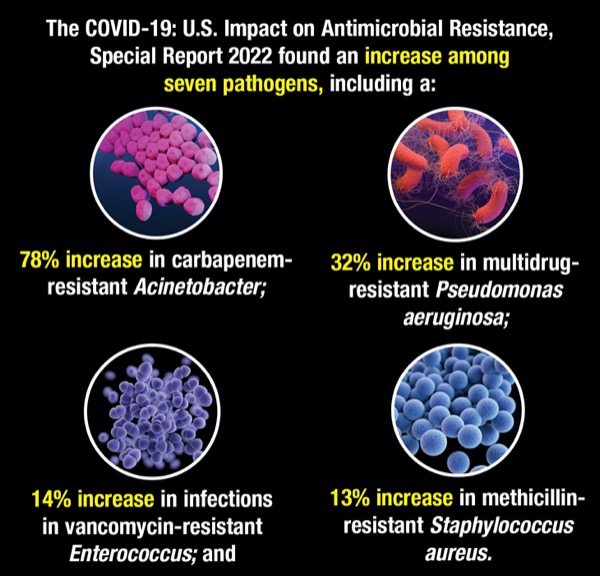
The CDC analyzed the state of AMR in the United States immediately after the 2020 peaks of the pandemic. The data show an increase in resistant infections starting during hospitalization that the agency called “alarming.” The COVID-19: U.S. Impact on Antimicrobial Resistance, Special Report 2022 found an increase among seven pathogens, including a:
- 78% increase in carbapenem-resistant Acinetobacter;
- 32% increase in multidrug-resistant Pseudomonas aeruginosa;
- 14% increase in infections in vancomycin-resistant Enterococcus; and
- 13% increase in methicillin-resistant Staphylococcus aureus.
Antifungal resistant threats also rose in 2020; Candida auris increased 60% overall, and other Candida species increased 26%.
Clostridioides difficile is the only healthcare-associated pathogen to improve in 2020, likely driven in part by changes in healthcare-seeking behavior that resulted in fewer antibiotics being prescribed.
By comparison, a 2019 report showed AMR infections falling by 27% from 2012 to 2017. These reductions continued in hospitals until the pandemic began.
The CDC data demonstrate significant surges in antibiotic use and difficulty in following infection prevention and control guidance during the pandemic. Hospitals experienced personal protective equipment supply challenges, staffing shortages and longer patient stays. Staff also treated sicker patients who required more frequent and longer use of medical devices, such as catheters and ventilators.
Antibiotics were often the first option given to treat those who presented with pneumonia-like symptoms of fever and shortness of breath, even though many patients had SARS-CoV-2 infection, for which antibiotics are not effective. From March to October 2020, almost 80% of patients hospitalized with COVID-19 received an antibiotic.
Although some of this prescribing can be appropriate when risks for related bacterial or fungal infections are unknown, this high level of prescribing also can put patients at risk for side effects and create a pathway for resistance to develop and spread, according to the CDC.
The impact of the pandemic likely resulted in an increase of healthcare-associated, AMR infections, the CDC said. During the first year of the pandemic, more than 29,400 people died from AMR infections commonly associated with healthcare. Of these, nearly 40% acquired the infection during a hospital stay.
The total national burden of deaths from resistance may be much higher, but data gaps caused by the pandemic hinder that analysis because many clinics and healthcare facilities with limited services served fewer patients, or closed their doors entirely after COVID-19 did not report resistance data, the CDC said.
Data are unavailable or delayed for nine of the 18 pathogens listed in the CDC’s 2019 report, which estimated that more than 2.8 million AMR infections occur in the United States each year, with more than 35,000 people dying as a result.
“The COVID-19 pandemic has unmistakably shown us that antimicrobial resistance will not stop if we let down our guard,” said Michael Craig, MPP, the director of the CDC’s Antibiotic Resistance Coordination & Strategy Unit.
“The best way to avert a pandemic caused by an antimicrobial-resistant pathogen is to identify gaps and invest in prevention to keep our nation safe,” he added.
Denise Cardo, MD, the director of the CDC’s Division of Healthcare Quality Promotion, said emphasis should be placed on expanding existing prevention strategies that have proven effective. “The 2021 launch of the Global AR Lab and Response Network and the Global Action in Healthcare Network is an example of how aggressively CDC is moving to combat antimicrobial resistance not only in the U.S., but in nearly 50 countries across the world.
“We made significant progress before the pandemic, and I’m confident that we will make significant progress going forward.”
The agency said it remains committed to the U.S. National Action Plan for Combating Antibiotic-Resistant Bacteria, and will move forward by addressing gaps in the public health system and exploring investments in U.S. healthcare infrastructure in the following key areas:
- Enhance data systems and sharing. Expanding automation of electronic data to allow healthcare facilities and systems to have information they need about antibiotic use and AMR.
- Infection control. Continuing to offer high-quality infection prevention and control training to every healthcare professional and to healthcare facilities beyond hospitals, such as nursing homes and other long-term care facilities. This also means educating the public on how they can stop the spread of germs and practice infection prevention in the communities where they live and work.
- Antibiotic/antifungal use and access. Optimizing antibiotic use across all healthcare settings and implementing the CDC’s Core Elements across healthcare settings. In addition, working to promote optimal antibiotic and antifungal use and tracking for companion animals and agriculture.
- Environment and sanitation. Expanding the capacity of the National Wastewater Surveillance System to collect AMR data from wastewater treatment plants and healthcare facilities, studying resistance in community and healthcare wastewater domestically and globally.
- Vaccines, therapeutics and diagnostics. Enhancing interagency collaboration to accelerate research for developing new antibiotics, antifungals and therapeutics.
“I applaud this CDC report that highlights the need to stay focused on antimicrobial resistance,” said Debra Goff, PharmD, FIDSA, FCCP, an infectious diseases specialist in antibiotic stewardship at The Ohio State University Wexner Medical Center, and a professor of pharmacy practice in the Department of Pharmacy at Ohio State, in Columbus.
Although the report highlights many ways to address AMR, Dr. Goff stated that, “I think the CDC missed the opportunity to call out the need for antibiotic stewardship programs [ASPs]. They state infection control programs [ICPs], and I agree ICPs are important, but I would have liked to see the CDC report state ASPs need continued funding if we want to avert an AMR pandemic.
“Hospital administrators and CEOs pay attention to CDC reports. ASPs are implied in the statement to ‘optimizing antibiotic use across all healthcare settings,’ but without specifically naming that this critical activity is done by ASP teams, it’s a missed opportunity by the CDC to advocate for ASP. CEOs and hospital administrators will not know who does this work. ASPs will continue to struggle for funding. I am disappointed,” Dr. Goff said.
Daniel P. McQuillen, MD, FIDSA, the president of the Infectious Diseases Society of America, called for systemic changes. “This is no longer a future crisis but one that is at America’s doorstep and needs to be addressed now. Whenever there are high levels of hospitalizations, rates of antimicrobial-resistant infections and deaths will likely further increase unless we take steps to prevent them,” he said, adding that Congress must act.
More federal funding is needed for resistance programs, surveillance and prevention, and Dr. McQuillen reiterated Mr. Hyun’s call for approval of the PASTEUR Act.
“Passing the bipartisan PASTEUR Act—which funds the development of new antibiotics as well as stewardship efforts to guide judicious antibiotic use—should be a top priority for Congress,” Dr. McQuillen said in a statement.
“Infectious diseases experts make hospitals safer for patients, but they need the right tools. The U.S. must invest in new antibiotics, smarter antibiotic use, and the recruitment and retention of more ID physicians to lead infection control and antimicrobial stewardship efforts at U.S. health care facilities,” Dr. McQuillen added.
This article is from the August 2022 print issue.
Please log in to post a comment