





Whenever my attendings would ask me about my journey with cancer, one of the most common questions I was asked was “Did you notice any symptoms before you were diagnosed?”
My answer was always the same: “I felt tired, but don’t all surgery residents feel tired?”
I had just started a burn surgery rotation at Maricopa, in Phoenix, when I noticed I had an enlarged lymph node above my left clavicle. I tried not to think too much of it but knew it was abnormal, so I threw an ultrasound on it myself and could tell it was bigger than the average lymph node. I got a formal ultrasound, which showed a cluster of enlarged nodes there, with the largest being 3 cm. I called the attending on call at my home institution, who shared my concern and ordered a stat CT for further evaluation.
After a CT scan, a PET scan, a testicular ultrasound, an EGD and an excisional biopsy, I had my answer: Hodgkin lymphoma (HL), stage IIB. The nodes I felt above my left clavicle lit up like Christmas on my PET scan, as did nodes in one of my axillae, my chest wall, around my trachea and in front of my heart. I was presented at my hospital’s tumor board that week, which I would normally be present for to discuss my own patients but decided it would probably be best to sit out for once. There was plenty more to follow in the short couple of weeks before starting treatment, including an echo, pulmonary function tests, a port in my right chest, and appointments with my medical and radiation oncologists.
There was a healthy dose of uncertainty that came with all of the above. Some of that is inherent in a new cancer diagnosis, which I see with almost all of the patients and families to whom I’ve had to break bad news. Thankfully, I’ve had the opportunity to take care of patients with HL before, and had to familiarize myself at the time with some of the basics that come with it. That part was easy. What was more difficult, and what I found myself asking my oncologist the most questions about, was whether or not I’d be able to continue working throughout my treatment. Surgical residency is a gantlet, and I didn’t want to let this obstacle beat back all of the progress I had made in becoming a better surgeon.
Thankfully, my oncologist said I would be able to keep working so long as I felt OK enough to do so. He did relay that one common side effect of the chemotherapy is peripheral neuropathy, which obviously could become problematic. But as long as that was manageable, he gave me the green light, and the neuropathy is only temporary for most patients. I was incredibly relieved that I didn’t have any hard-and-fast obstacles to continue doing what I love doing (outside of a day or two off every other Thursday for treatment, of course). He did warn me that the effects of my proposed chemotherapy regimen would be cumulative and that I’d feel worse as time went on, but I figured I could put that off until a later date.
I started chemotherapy on March 24, 2022. At first, I’d feel terrible for the entire day of chemo, slightly less terrible the weekend after, and progressively better over the ensuing week and a half until my next treatment. In the beginning I was even afforded a few days toward the tail end of my cycles when I’d feel something close to normal! Most importantly, it only took a few treatments before I felt the lymph nodes above my clavicle melt away to normal again. My oncologist said that was a good sign, and a PET scan after two cycles confirmed my hope that I was having an essentially complete response.
Unfortunately, my oncologist’s warnings about side effects came through, and the side effects of chemo lasted longer and hit a bit harder as time went on. The fatigue was nearly constant; the neuropathy spread from my fingers to my feet and toes; and every meal choice was determined by whether or not I could handle the reflux that would inevitably come with it. Hiccups came with taking steroids for anti-nausea purposes, which I ultimately had to self-discontinue to stop hiccupping so much. To top it off, three weeks before finishing chemo, I noticed pitting edema in my right leg after getting home from work. An informal ultrasound from our vascular clinic ultrasonographer and a curbside self-consult from my program director later, I was on anticoagulation for deep venous thrombosis. None of this was fun by any stretch.
I was able to continue working throughout my treatment, and most importantly, I was able to keep operating. Maybe my feelings were somewhat misplaced, but I felt a sense of pride in soldiering on despite this unfortunate roadblock. I rang the bell on Aug. 25, and my final PET scan a few days later confirmed a complete response. I was finally cancer-free, and more importantly, free of the miserable guardrails that came with being a surgery resident while undergoing chemo.
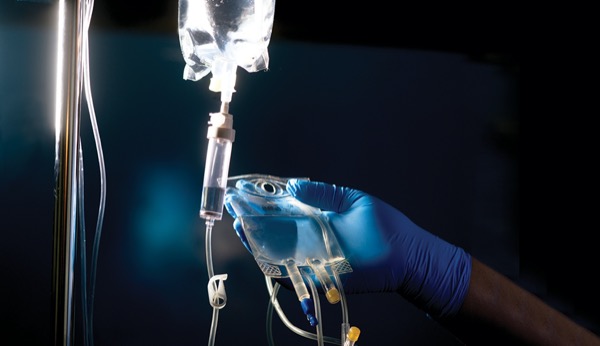
Six cycles of chemotherapy with two treatments per cycle left me with a lot of time in the oncology clinic to think about what I was experiencing. Mostly, I spent time looking around the clinic and wondering what the other patients around me were going through. I found myself realizing that so often as a surgery resident, I would see a cancer patient after their operation, send them off to oncology and not hear from them again for months at a time. Those months between visits would pass quickly on my end, but I can’t imagine they did so for the patients who were tethered to an IV pole every week. It certainly didn’t feel quick for me.
Over the course of my treatment, I only recognized one patient sitting around me. She was the wife of a patient I had taken care of in the hospital who had had a complication under my care that required a prolonged admission. She herself was undergoing treatment for breast cancer and was a patient of our clinic. It felt especially fitting that this would be the one person I would recognize during the entire course of treatment. It sticks in my mind as a stark reminder that every patient has their own load to bear that we, as physicians, only have the privilege of seeing a glimpse of. All we can do is try to make that load a little lighter.
I don’t have anything profound to say to summarize my experience as a surgery resident with cancer. At its most basic, I saw it as another hurdle I needed to clear in order to realize my dreams. But I can say without a doubt that I am better for having gone through it, and that it has already made me a better physician and surgeon. And while I fully expect to continue being another tired surgery resident for the next two years, hopefully after all of this, I’ll be a little less tired.
Special thanks are due to Drs. Matulonis, Alexander and Wiggins, and to the Wiliam Beaumont Army Medical Center oncology clinic, and to my program leadership and co-residents for helping to diagnose me, putting a port in me and always supporting me.
Dr. Myers is a surgery resident at William Beaumont Army Medical Center, in El Paso, Texas.
This article is from the March 2023 print issue.
Please log in to post a comment