






Ding!
What now? I glance down at my phone. “Are you OK continuing antibiotics for that last patient?” I send back a thumbs-up to the resident, and slipping past the wave of night float nurses waiting for the elevators, I start my daily commute from the hospital labyrinth to the adjacent parking garage. The automatic double doors reluctantly open as I approach, as if deliberating whether or not I deserve to leave. Did they hear about what happened in the OR today? Isn’t there some expression about if walls could talk? Are the doors and walls colluding against me?
Outside, I pause to take in my first daytime encounter. The sun clearly has better things to do and is obscured by the dense cloud cover overhead. There are scattered puddles on the ground that people are trying their best to avoid. I watch for a few seconds and it’s almost comical. But I join in the game, weaving right and left, carefully choosing the high ground. I try and think how many days in a row there’s been rain. Too many. But then again, can you really have too much irrigation?
I approach the pedestrian bridge, the conduit between the hospital and the staff garage. Here, the daily ebb and flow of labor and expertise takes place. The chalk art that was present in the morning is now partially washed off by the rain.
Heroe- -ork —re
Most of the positivity is now just streaks of diluted blue and red. But where was all that red coming from? I try and focus on some of the other art. In the center of the walkway, somebody had gone off script and drawn an absurdly large hopscotch course. The barely legible numbers disappear beneath my feet: 1 - 2 - 3 -
8 - 9 - 10. That should be long enough. I let the stapler fire.
A calming shadow slowly descends as the parking garage blocks out any remnant of sunlight left. The day and night shift continue to replace each other. A constant back-and-forth. Inflow. Outflow. The inflow on this particular evening isn’t as robust as usual. That could be a problem. Two nurses pass me, laughing.
This patient really cannot take a joke. The abdominal wound vac crinkles under the suction. How many pressors did they say she was on?
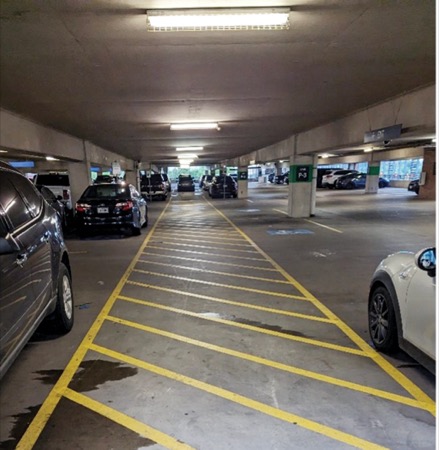
Suddenly I’m in the garage. The darkness feels welcome, so I let my steps slow down. I always arrive early enough in the morning to be one of the privileged few who can park on this floor and avoid stairs. The crosswalk looks weary tonight, its yellow paint peeling beneath the weight of thousands of feet. But the lines are perfect, every line evenly spaced. What was the recommended spacing these days? One centimeter from the edge? After as many operations as she had had, I was just lucky there was any tissue at all. I let the cars fall into and out of my peripheral vision, stopping periodically to focus on a vanity plate or bumper sticker. The fluorescence above me randomly flickers and dims.
Why is my visualization so poor? I adjust one of the OR lights to try and see into the pelvic cavern. I reach for another light. Two must be better, right?
The short blast of a horn from the other side of the garage jolts me back to the moment. I check my phone again for no reason. Nothing.
Nothing is working. If there ever was a gallbladder, it was long gone, replaced by this mutant mass on the screen. Maybe I can try and create some space right here.
Finally, I see my car up ahead. How many times have I made this exact same walk? Or the times when I get halfway and a phone call makes me retrace my steps, like an airplane forced to turn around after it was cleared for takeoff. But not today—I’m in the red zone. I stick a single bud into my right ear. I usually use the time in traffic to make a few phone calls.
A blind grab into my satchel produces two items: car keys and a flimsy needle driver. Smiling at the irony, I put the driver back in the bag and start my car.
This short story tries to capture the mental fragmentation that can occur at the end of a difficult day when your brain will just not let go. I feel a transition occur as I walk from the hospital to the parking garage. My brain goes from a state of second-guessing, replaying, internalizing, to a state of acceptance and calm—a process that takes about the distance of two football fields from door to car. Whatever this process looks like for you, allow yourself time and space to make that transition. Patient care is such a beautiful burden, and I am grateful for those who shoulder it.
Dr. Halgas is a general and burn surgeon in San Antonio. He is a member of the editorial advisory board of General Surgery News.
This article is from the August 2023 print issue.
Please log in to post a comment