
Originally published by our sister publication Anesthesiology News.
New research has come to some surprising, and potentially troubling, conclusions about the prevalence of Staphylococcus aureus colonization in spinal cord stimulation (SCS) patients.
The study found not only that colonization with the bacteria was present in more than 20% of SCS patients, but that methicillin-susceptible S. aureus (MssA) was nearly five times more prevalent than methicillin-resistant S. aureus (MRSA). Furthermore, MRSA screening alone would not have identified more than 90% of S. aureus–colonized patients with only MssA carrier status.
“Staphylococcus aureus accounts for a large percentage of implantable device infections,” said David Provenzano, MD, the president of Pain Diagnostics and Interventional Care, in Sewickley, Pa. “There are a few reasons for that. First, the bacteria are very common. The other issue is that Staphylococcus aureus is very good at creating a biofilm, which impedes the immune system’s ability to effectively fight device-related infection.
“Unfortunately, there is a subset of people that harbor Staphylococcus aureus on their skin,” he said. “We know that these carriers are independently at higher risk for a surgical site infection. So, the idea that’s been brought up in other fields is that if you can identify these individuals, you can then implement the appropriate decolonization protocol prior to doing the surgery and thereby lower the risk of infection.”
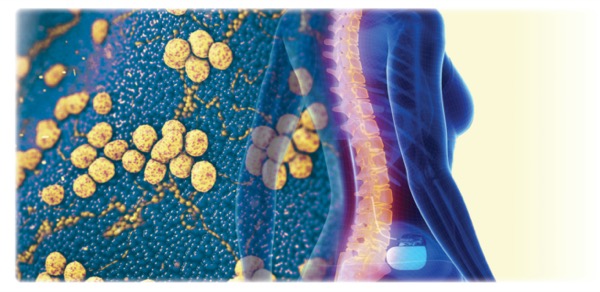
Such research has been virtually nonexistent in the field of neuromodulation, which led Provenzano, along with fellow researchers Alexander D. Keith, MD, and Jason S. Kilgore, PhD, to review the records of 232 SCS surgical patients. These individuals underwent 396 unique neuromodulation procedures (SCS trial, 227; SCS implantation, 156; battery replacement, 13). Of the entire cohort, all patients were screened for MRSA and 98.3% were screened for MssA.
After reviewing each patient’s preoperative swabs for S. aureus, the investigators found 23.3% (54/232; 95% CI, 18%-29.3%) were preoperatively colonized with the bacteria.
“A large portion of the population was colonized,” Provenzano said.
Notably, while only 4.3% (10/232; 95% CI, 2.1%-7.8%) were positive for MRSA, 20.2% (46/228; 95% CI, 15.2%-26.0%) were positive for MssA. Two patients were colonized with both types. Moreover, 95.7% of patients (44/46; 95% CI, 85.2%-99.5%) who had MssA were negative for MRSA. All patients who carried the bacteria were treated with mupirocin nasal ointment and chlorhexidine body wash. No post-procedural surgical site infections were identified.
The investigators also analyzed patient records for independent risk factors for S. aureus colonization. This analysis found anxiety was the only condition significantly associated with increased odds of MRSA colonization, and hypothyroidism was the only condition related to significantly increased odds of MssA colonization. Additionally, preoperative colonization with either MRSA or MssA was not significantly associated with:
- independent or combined histories of MRSA non–surgical site infections;
- non-MRSA non–surgical site infections;
- MRSA surgical site infections; and
- non-MRSA surgical site infections.
“This means you basically have to screen all comers to your clinic,” Provenzano said. “Of course, this begs the question of why we don’t just decolonize everyone that comes to the clinic, and not do the testing. But research has shown that decolonization only works on people that are colonized. So, if you want to have good stewardship and not waste agents that can lead to antibiotic resistance on people that don’t need it, you decolonize people that are colonized.”
For Provenzano, the findings helped demonstrate the importance of testing SCS patients for both MRSA and MssA—a step he believes will have a marked impact on patient outcomes.
“Most people are so focused on MRSA that they don’t test for MssA,” he said. “But if you only test for MRSA, you’ll miss close to 90% of the people that test positive for MssA. We know that whether you’re colonized with either one, you are independently at a higher risk of surgical site infection.
“In addition, I know from previous work that we’ve published that when a patient gets a device infection, it costs well over $50,000 in medical costs,” Provenzano said. “We also know from large claims data that only about 27% of patients ever get their device back.So not only is it very expensive, but it’s often device-ending. And for many people, these devices are the last chance for pain control.”
For Christine L. Hunt, DO, the results of the investigation make perfect sense.
“Colonization of either MRSA or MssA is something that has been the topic of considerable discussion in our field for some time,” commented Hunt, the vice chair of quality in the Department of Pain Medicine at Mayo Clinic in Jacksonville, Fla. “This work really highlights how important it is that we screen for both types of colonization and all patients, regardless of comorbidities that might present risk factors.”
Yet as Hunt pointed out, the sensitivity of the tests may play a role in these efforts. “How sensitive are the tests for colonization? Is there a risk we’ll miss a significant number of colonized patients who should be decolonized, but because they tested negative, are not? We want to make sure that we’re using screening tests that are highly sensitive.”
Finally, Hunt believes that any patient who cannot be screened for MRSA or MssA should undergo a decolonization protocol. “Maybe that’s a good question to examine, the cost and feasibility of standard decolonization for all patients.”
The study was presented at the 2022 annual meeting of the North American Neuromodulation Society in Orlando, Fla.
—Michael Vlessides
Provenzano reported financial relationships with Avanos, Boston Scientific, Heron, Medtronic, Nevro, SI Bone and Wise. Pain Diagnostics and Interventional Care has received research support from Abbott, Avanos, Boston Scientific, Medtronic, Nevro and Stimgenics.