

Bile acids are stuff you make in the liver, store in the gallbladder (unless you have had a cholecystectomy) and excrete via the ampulla of Vater into the duodenum to emulsify the fats you’ve eaten. That’s it? Not at all! There is so much more to bile acids.
Chemistry
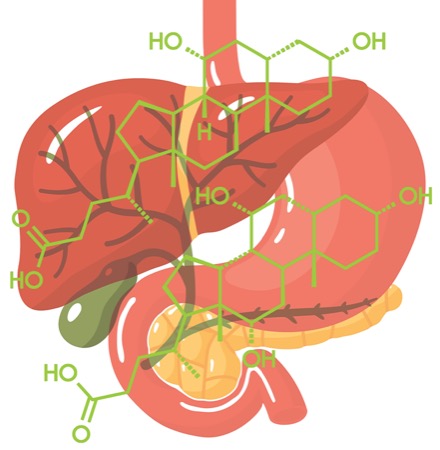
Bile acids chemistry is the logical starting point for understanding the role of bile acids in the body’s metabolism. Bile acids are synthesized directly from cholesterol and are, therefore, a steroid derivative, which is defined as consisting of 24 carbon atoms with three six-member rings (A, B, C) and one five-member ring (D), plus a seven-carbon side chain coming off the five-carbon ring.
The two primary human bile acids synthesized in the liver are cholic acid and chenodeoxycholic acid, differing in structure in that cholic acid has an additional hydroxyl group attached to the top of the “C” ring. These primary bile acids are conjugated in the liver to glycine or taurine to increase solubility. Secreted into bile, the primary bile acids enter the small intestine where they are modified into the secondary bile acids, primarily lithocholic and deoxycholic, by intestinal bacteria. In normal physiologic function, bile acids have the body’s most efficient enterohepatic cycle with 95% reabsorption from the intestine, primarily from the ilium. Thus, the same bile acids can be used for breakfast, lunch and dinner.
Interruption of the Enterohepatic Circulation
Partial Ileal Bypass
In 1962, I proposed the partial ileal bypass operation to lower plasma cholesterol levels and mitigate atherosclerosis. Isotope research of mechanisms demonstrated that this operation, by bypassing the ileum, the primary site for bile acid and cholesterol enterohepatic reabsorption, wastes bile acids and cholesterol in the stool, causing the liver to replenish the bile acid pool by synthesis from cholesterol. In turn, the plasma and tissue cholesterol concentrations are reduced, including cholesterol in arterial plaques.
After several National Heart, Lung, and Blood Institute site visits, the Program on the Surgical Control of the Hyperlipidemias (POSCH) was funded. This $65 million randomized controlled trial (RCT) utilized the partial ileal bypass as the intervention modality. POSCH was conducted in four separate geographic locations. It was the first metabolic surgery RCT funded by the National Institutes of Health. POSCH was also the first RCT to confirm the lipid/atherosclerosis hypothesis (N Engl J Med 1990;323:946-955). POSCH demonstrated statistically significant decreases in post-myocardial infarction patients for subsequent heart attacks, sudden death, peripheral vascular disease and coronary revascularization procedures. In addition, sequential coronary arteriograms at zero, five, seven and 10 years showed retardation and actual regression of atherosclerotic plaques. Over time, the POSCH partial iliac bypass cohort had an increase in life expectancy. In a confirmatory animal study, this enterohepatic interruption procedure showed quantifiable reductions in cholesterol arterial deposits and fibrotic stabilization of atherosclerotic plaques.
Bariatric Surgery
One of the proven metabolic benefits of bariatric surgery is mitigation of hyperlipidemia—indeed, reduction of lipid levels below postulated norms. A primary mechanism for this effect is interruption of the enterohepatic bile acids and cholesterol cycles, particularly by the jejunoileal bypass, biliopancreatic diversion, duodenal switch and modified duodenal switch procedures.
Catharsis
The bile acids that are not reabsorbed and reach the colon are the body’s endogenous cathartics and aid in the regulation of bowel movements. Thus, after intestinal flow diversion from the colon (e.g., bile fistulas) constipation can ensue, whereas enhanced bile acid concentration in the colon—found after cholecystectomy (transient or persistent), partial ileal bypass and intestinal bariatric surgery—commonly causes increased frequency of bowel evacuations.
Obesity
Obviously, bile acids facilitate intestinal fat absorption, the highest caloric content food substance (9 calories/g in contrast to 5 calories/g for carbohydrates and protein). Bile acids also possess a hormonal-like function as signaling molecular ligands. They act on the nuclear farnesoid X receptor (FXR) and the membrane Taketa G-protein coupled receptor 5 (TGR5), which, in turn, regulate the gut hormones glucagon-like peptide 1 (GLP-1), gastric inhibitory polypeptide, PYY, ghrelin and leptin associated with obesity. Higher-than-normal blood levels of circulating bile acids are a marker for obesity and fluctuate with body mass index.
Obese patients on diet therapy lower their circulating bile acids concomitant with weight loss. Paradoxically, bariatric surgery increases circulating bile acids, as well as changing their relative composition. These phenomena attest, once again, that bariatric surgery is metabolic in its mechanisms and not purely a function of caloric restriction. Increasing circulating bile acids after metabolic/bariatric surgery may represent a hormonal bile acid function to maintain bodily homeostasis in light of metabolically engendered weight loss, as well as a response to the interruption of the enterohepatic bile acids circulation and increased bile acids excretion.
Type 2 Diabetes
The bile acid receptors FXR and TGR5 are found in pancreatic beta cells and serve as mediators of blood glucose levels and energy expenditure, as well as exercising reciprocal negative feedback on the bile acid pool. This bile acid initiated hormonal cascade stimulates the release of GLP-1, which, in turn, regulates insulin. Bile acids as controlling factors in insulin secretion have led to clinical studies of bile acids administration as therapy for type 2 diabetes
The initiated pathology of type 2 diabetes is generally accepted to be the onset of peripheral insulin resistance and subsequent compensatory increased insulin secretion by the pancreas. Would it not make more sense that the initiating factor resides in an excessive hormonal stimulation of the beta cells resulting in hyperinsulinemia, which then causes peripheral insulin resistance as a cellular defense mechanism?
Nonalcoholic Fatty Liver Disease
Serum concentrations of primary and secondary bile acids are increased in patients with nonalcoholic fatty liver disease (NAFLD), and the relative bile acid pool composition is altered. In addition, the bile acid FXR receptor is decreased. The exact relationship of these alterations to the development and progression of NAFLD is unclear. Paradoxically opposed mechanisms have been proposed. It has been suggested that the altered bile acid profile may promote NAFLD progression. It has also been suggested that the increased bile acids in NAFLD may serve to enhance FXR levels to counter NAFLD progression.
Cardiovascular Disease
Hepatic cirrhosis is known to increase serum bile acid concentrations. This phenomenon is to be expected secondary to impaired bile acid clearance by a fibrotic liver. It has also been demonstrated that excess circulating bile acids decrease fatty acid oxidation in cardiomyocytes, which leads to cardiac dysfunction. Of note, lowering bile acids and the bile acids progenitor cholesterol by cholestyramine, partial ileal bypass and bariatric surgery can ameliorate this finding.
The Intestinal Microbiome
Bile acids and the intestinal microbiome reciprocally regulate each other. By eliciting various metabolic transformations, they play a major role in maintaining body homeostasis and good health. At the same time, under adverse circumstances, they can exercise a negative function in diseases of the liver, type 2 diabetes and hypercholesterolemia.
The microbiome is responsible for converting the hepatic-synthesized primary bile acids to the secondary bile acids, which exercise their signaling properties via the FXR and TGR5 receptors. The engendered homeostatic metabolic cascade is altered by internal and external factors that can promote dysbiosis and metabolic disease consequences. It is only recently that these metabolic functions of intestinal bacteria and emulsifiers have been appreciated and are under investigation.
In addition to the microbiome regulatory effect on bile acids, bile acids maintain and alter the bacterial composition of the biomere by selecting species and their relative percent circulation. These actions take place directly by interactions within the gut and indirectly by activating innate immune response genes in the small intestinal wall. Under current investigations of these interactions are the associations of the microbiome with childhood allergies, inflammatory bowel disease, type 2 diabetes, NAFLD and other metabolic diseases. It has been shown that the simple ratio of Firmicutes/Bacteroidetes bacteria may be a causative factor or a signature marker of obesity. In this respect, as well as in many other disease states, the bile acids altered microbiome exerts its influence via the well-established gut–brain neurohormonal axis.
Immunity, Inflammation And Other Functions
Many bodily functions in health and in disease have been demonstrated to have a relationship to bile acids. This association has prompted investigators in different specialties to study immunity and inflammation, fundamental underlying mechanisms related to bile acids. Initial research outcomes from these investigations will increase our knowledge base and understanding of the human cosmos. Subsequently, they will elucidate pathways of healing and the use of therapeutics.
Reflection
Since my earliest research days on the interruption of the 95% efficient bile acids, and the 60% efficient bile acids progenitor cholesterol, enterohepatic cycles as the basis for the plasma and tissue cholesterol reductions embodied by the partial ileal bypass, I have been curious about why the body is so conservative of these two metabolites. To my knowledge, the body is nowhere nearly as stingy with any other complex metabolite. The currently available knowledge regarding the ubiquitous bodily processes involving bile acids may provide an explanation.
With apologies to Tolkien: Bile acids are the ring that binds them all.
Dr. Buchwald is a professor emeritus of surgery and biomedical engineering, and the Owen H. and Sarah Davidson Wangensteen Chair in Experimental Surgery, at the University of Minnesota, in Minneapolis. His articles appear every other month.