
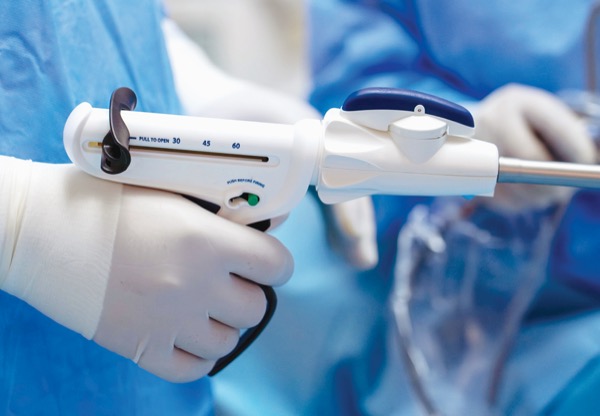
CLEVELAND—Laparoscopic endoscopic staplers, or bedside stapling, used in robotic bariatric procedures are not only as effective as robotic staplers, but also result in fewer ICU stays, a new study has concluded.
The investigation also found that use of bedside staplers was associated with significantly reduced healthcare resource utilization compared with robotic staplers.
According to Helmuth T. Billy, MD, few studies have examined the feasibility of bedside stapling in robotic bariatric procedures. “We wanted to compare the effectiveness and outcomes of bedside stapling with those from a robotic stapler because those choices may have an important impact on the delivery of care,” said Dr. Billy, the medical director of bariatric surgery at Ventura Advanced Surgical Associates, in Ventura, Calif.
Dr. Billy and his co-investigators analyzed the records of 7,268 patients in the PINC AI Healthcare Intelligence Engine who underwent robotic sleeve gastrectomy or gastric bypass as elective procedures in 2021. Of the group, 1,603 had bedside stapling while the remaining 5,665 underwent robotic stapling. The researchers assessed effectiveness through both clinical outcomes (blood transfusion, bleeding, anastomotic leak, ICU visit and 30-day readmission) and resource utilization (OR time, inpatient costs and length of stay).
Reporting at the 2024 annual meeting of the Society of American Gastrointestinal and Endoscopic Surgeons, Dr. Billy explained that although the two study groups were largely similar, there were several exceptions. The robotic stapling group had a greater proportion of Hispanic patients (17% vs. 9.4%), patients with Medicaid (26.9% vs. 19.4%) and those who underwent sleeve gastrectomy (68.4% vs. 53.5%). Similarly, a larger proportion of robotic stapler cases were performed by providers in the Northeast region (35.5% vs. 24.3%), in urban areas (97.2% vs. 92.4%), in hospitals of smaller size (500 beds; 71.1% vs. 52.3%) and in teaching hospitals (59.4% vs. 39%).
After adjusting for potential confounders, the study found that patients who underwent robotic stapling were significantly more likely to have:
- blood transfusions (odds ratio [OR], 2.4; 95% CI, 1.1-5.0; P=0.022);
- ICU stays (OR, 8.5; 95% CI, 2.0-37.0; P=0.004);
- increased OR time (19 minutes; P<0.001); and
- higher cost of care ($1,257; P<0.001).
A sensitivity analysis yielded similar results, except blood transfusion rate did not differ significantly between the two modalities.
The investigators also performed a subgroup analysis to compare the effectiveness of manual/intelligent bedside staplers with robotic staplers. The manual/intelligent bedside staplers were found to be statistically significantly superior in terms of:
- ICU visits (OR, 17.2; 95% CI, 1.1-275.3; P=0.044);
- OR time (31.6 minutes; P<0.001); and
- costs ($2,670; P<0.001).
“Length of stay is often talked about when it comes to stapling technique,” Dr. Billy noted. “But we found that although length of stay was statistically significantly shorter with the robotic staplers [0.26 days vs. bedside staplers and 0.16 days vs. manual/intelligent bedside staplers], these differences are not really something that we can easily to turn into value, because that could be the time the physician came in to round.”
In view of these findings, the researchers concluded that bedside staplers are as effective as robotic staplers in bariatric robotic procedures, with the added benefit of saving on costs.
“Bedside stapling significantly reduced healthcare resource utilization,” Dr. Billy said. “This is important as we look to the future and decide whether this will become a sustainable platform for more procedures, and in smaller hospitals as well.”
For Michel Gagner, MD, the results of the investigation came as little surprise.
“I recall when the first laparoscopic stapler came out in the early 1990s,” said Dr. Gagner, the chief of surgery at Westmount Square Surgical Center, in Montreal. “It wasn’t great, and there were frequent leaks. Over the past 30 or 35 years, though, manufacturers have improved these staplers an incredible amount. They have a good history, good bench testing and good quality.
“Meanwhile, the robotics companies realized that they needed to have their own staplers,” Dr. Gagner added. “Nevertheless, they don’t have the same history or engineering experience as the laparoscopic companies. So, I’m not surprised to see that the bedside staplers are much better than the robotic ones.”
Although it has yet to receive regulatory approval in the United States, Dr. Gagner believes that magnetic compression anastomosis may soon provide an alternative to both laparoscopic and robotic staplers.
“The magnets make an anastomosis that is very slow,” he explained. “You don’t have to cut or open bowels like you do with sutures and staples, and the technology essentially removes the risk of bleeding and leaks. And if patients begin to learn about the magnetic approach, they might ask for it because of its safety profile.”