
SAN FRANCISCO—Concluding our coverage of the perennially popular “10 Hot Topics in General Surgery,” from the 2024 Clinical Congress of the American College of Surgeons, General Surgery News looks at the final three presentations from the session.
Telesurgery Is Possible Today
Jay A. Redan, MD, the chief of surgery with AdventHealth in Celebration, Fla., discussed the possibility of incorporating telesurgery into today’s practice, a process he said began with a comprehensive review of robotic surgical platforms and their use in a variety of surgical procedure types.
“But all of these devices need surgeons to educate and train our colleagues on their proper use, and there are not enough people out there in the world to go to these sites,” he said.
Given such shortcomings, Dr. Redan helped assemble a cadre of experts in the field to discuss telesurgery, the result of which was a 2024 publication titled “Technical and Ethical Considerations in Telesurgery” (J Robot Surg 2024;18[1]:40). “The question is not why we can’t do it but really how we can,” he noted.
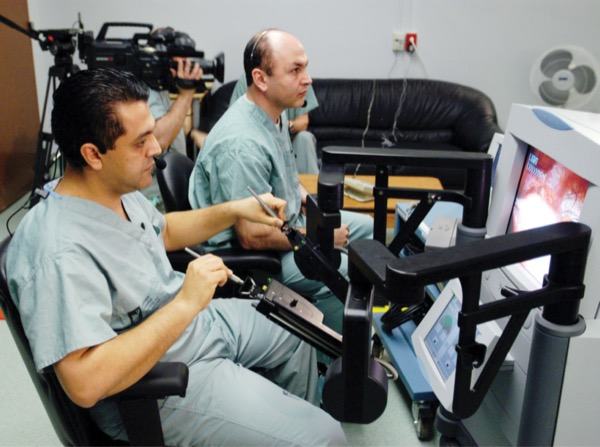
To help answer that question, Dr. Redan and his colleagues worked extensively with surgeons in China (a favorable regulatory environment), and then performed a live case using a surgeon in Beijing and a patient in Harbin, some 800 miles away. The result was a successful radical prostatectomy by Vipul Patel, MD, with assistants in the room with the patient, ready to take over the controls if necessary.
“So, this can be done, and we’re continuing to do this,” Dr. Redan noted.
Subsequent latency tests on animals have found 255- and 139-milisecond delays between Orlando, Fla., and Shanghai. Once the researchers started using trans-Pacific fiberoptic cables, however, that delay was all but eliminated. Future efforts will look into the possibility of performing telesurgery in more austere environments using satellite-based internet systems.
Of interest, many of the robotic surgical devices currently on the market have telesurgical capabilities built into them. “It’s just a matter of unlocking the software so we can all help our colleagues throughout the world perform safe robotic surgery,” Dr. Redan noted.
The FDA also has created a collaborative community on telesurgery, a forum Dr. Redan said will help promote use and acceptance of the technology.
Nonantibiotic Treatment For Diverticulitis
Alexander T. Hawkins, MD, MPH, an associate professor of surgery at Vanderbilt University Medical Center, in Nashville, Tenn., dove into the details and data surrounding nonantibiotic treatment for diverticulitis, beginning with three well-powered European trials he said should help clinicians decide whether such a strategy is a viable treatment option: DIABOLO (2010), AVOD (2012) and DINAMO (2021).
“All three had primary outcomes that were essentially resolution of abdominal pain or some sort of return to the hospital,” he said. The three studies found no significant difference in primary outcomes between patients who were and were not treated with antibiotics for diverticulitis.
Given such findings, national guidelines have changed over the past few years, including those of the American Gastroenterological Association, American Society of Colon and Rectal Surgeons, and American College of Physicians, all of which now offer a non–antibiotic-based option for the treatment of diverticulitis.
Of course, a nonantibiotic approach carries a number of potential benefits, including the avoidance of side effects such as nausea, diarrhea, anaphylaxis and Clostridioides difficile infections; reduced costs; and antimicrobial stewardship. Yet there are potential risks in avoiding antibiotics as well, including the risk for disease progression to complicated diverticulitis.
Despite its potential benefits, nonantibiotic treatment is not for everyone, including patients with an abscess or frank perforation, septic patients, immunosuppressed patients, patients with a high comorbidity burden, and those unwilling to pursue a nonantibiotic approach.
“You’ll get patients who are very resistant to this, and I don’t think that’s the time to force the issue,” Dr. Hawkins said.
Clinicians interested in imple- menting a nonantibiotic approach should begin by rehearsing the conversation with their patients, which can sometimes be awkward. It is also helpful to make the decision as a practice, not as an individual. Finally, surgeons should offer support in the case of treatment failures, should they occur.
“So, have a check-in with them yourselves or have your nursing staff check in with them just to make sure that they are, indeed, getting better,” he added.
Management of CBD Stones: No Stone Left Behind
Irving A. Jorge, MD, an assistant professor of surgery at Mayo Clinic in Arizona, Phoenix, was the session’s final speaker, dedicating his talk to minimally invasive CBD exploration, including laparoscopic and robotic approaches.
“My first question is this: Is minimally invasive common bile duct exploration better than ERCP?” he asked. Each offers benefits. For ERCP, these include the fact that it’s been standard of care for more than two decades, is a more experienced procedure and does not add to the surgeon’s operative time. Minimally invasive exploration, on the other hand, benefits from decreased length of stay, comparable clearance rates and an 80% to 90% single-stage efficacy rate.
In 2018, a systematic review and meta-analysis of randomized trials found that single-stage laparoscopic CBD exploration (CBDE) and cholecystectomy had a significantly higher clearance rate and lower length of stay than two-stage preoperative endoscopic stone extraction followed by cholecystectomy, with equal morbidity and mortality (Surg Endosc 2018;32[9]:3763-3776). These findings have since been reproduced in the adult and pediatric literature.
“If MIS [minimally invasive surgical] CBD exploration is better, is ERCP worse?” he asked.
This question may have been answered in a 2022 article that found a fivefold increased risk for hepatobiliary cancers in patients who had undergone ERCP with a sphincterotomy (Scand J Surg 2022;111[3]:39-47).
Stones less than 6 mm in diameter can be cleared by passing a wire and a balloon, dilating the ampulla, pulling the balloon back, and flushing. Larger single stones can be retrieved with a basket, assuming it’s smaller than the diameter of the cystic duct. Stones larger than that will likely require lithotripsy, which preserves the integrity of the bile duct and allows the fragments to be flushed into the duodenum. Robotic CBDE is also a possibility, Dr. Jorge said.
Is there a value associated with performing CBDE? A 2022 analysis found that surgical productivity increases markedly with the procedure (J Gastrointest Surg 2022;26[4]:837-848). “And from an institutional standpoint, a CBD exploration, single-stage procedure is the most cost-effective algorithm to manage these patients,” he added.
Although laparoscopic CBDE is still not commonly performed by surgeons, this gap can be bridged with increased access to equipment and training. Similarly, simulation-based training has been shown to increase the adoption and utilization rate of CBDE. Luckily, multiple courses on the technique are available from a variety of sources, including the Society of American Gastrointestinal and Endoscopic Surgeons and American College of Surgeons.
“In summary, I would say MIS-CBDE, either laparoscopic or robotic, should be first-line therapy for stones,” Dr. Jorge concluded. “Let’s change course and leave no stone behind.”