
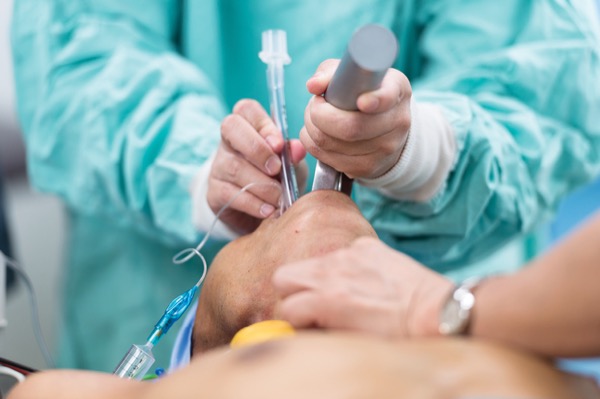
Respiratory compromise requiring intubation is an infrequent but dire complication in trauma patients with rib fractures. Using an interpretable machine learning model, researchers studying this patient population have identified predictors of intubation, some of which had not been identified by former models.
“There have been similar models for predicting unplanned intubations, but they used older methodologies that may not capture more complex relationships between variables, may not be generalizable in all patients admitted to the hospital and may not be as useful for early identification of risk,” said Shamir Harry, a medical student at the University of South Florida, in Tampa, presenting the study at the 2025 Southeastern Surgical Congress.
To conduct their study, Mr. Harry and his colleagues used the trauma quality improvement database to identify 905,615 adult patients with rib fractures and an Injury Severity Score (ISS) higher than 0 admitted between 2017 and 2022. The intubation rate was 2.3, defined as occurring during the patient’s initial stay and for those intubated in the field, emergency department (ED) or OR, or requiring re-intubation more than 24 hours after extubation.
“We wanted to identify early predictors of risk, so we focused on variables that could be reasonably known at hospital admission including demographics, injury characteristics, ED variables and hospital-level attributes,” Mr. Harry said.
The researchers conducted a univariate analysis to compare patients who had an unplanned intubation with those who did not.
They used an XGBoost (eXtreme Gradient Boosting) approach for their machine learning model because that strategy works well with large-scale tabular imbalanced databases (imbalanced meaning the number of unplanned intubations was far less than the number of non-intubated patients). “It also has an innate capability to handle missing values,” Mr. Harry said.
The univariate analysis showed that patients with an unplanned intubation were more likely to be male, white, older, with a higher incidence of all comorbidities and to have a higher ISS for nearly all types of injuries.
The most influential variables were sex, age, ED discharge disposition, absence of comorbidities, chronic obstructive pulmonary disorder, ISS, pulse rate, pneumothorax, oxygen saturation and respiratory rate—the latter five of which had not been identified in previous models.
Higher predictive odds of unplanned intubation were seen in patients admitted to the OR/ICU in those with an ISS between 20 and 60 and those with a pulse rate higher than 100 beats per minute.
“Our next step would be to validate these findings on real-time prospective patient data to really assess its tangible clinical utility, and with that you can integrate it into a clinical system as a risk prediction calculator to help guide overall clinical decision-making,” Mr. Harry said.
Richard Anderson, MD, the Norman Estes Professor at the University of Illinois College of Medicine in Peoria, who reviewed the study prior to its presentation, observed that as rib fractures are common among trauma patients and carry significant morbidity and potential mortality, being able to predict those in need of more advanced care could potentially help to avoid some of those complications.
“The authors have elaborately shown us an AI [artificial intelligence] model that may be able to predict patients who might get into trouble. But I was surprised that the number of rib fractures or the presence of flail segments made no difference. Also, what can we do with this information now to prevent some of these complications in the future?” Dr. Anderson asked.
Mr. Harry said the model did not find number of rib fractures or flail chest significant in terms of prediction. “That doesn’t necessarily mean they are not; it just means the model didn’t find those.”
As for applying the findings in the present, Mr. Harry responded, “you can say which variables are important and which are not, and hypothesize which variables to focus on as opposed to others. But I don’t want to take the next step toward interventions because that would be overextending what our results can state at this point. But that would be the next level.”