
Most discussions about the cost of being a surgeon focus on the enormous expense of medical education, with a four-year degree estimated at nearly $300,000 at public schools and almost $400,000 at private ones. But there are also costs associated with advancing in an academic career. One cornerstone of that advancement—society membership and meeting attendance—can be quite expensive, according to a recent study that drew considerable attention at the 2025 Southeastern Surgical Congress.
“When discussing career advancement, we tend to talk more about the papers you need to write, the grants you have successfully funded, the committees you need to sit on. But the reality of what an assistant professor or [a] junior faculty member is going to personally spend to successfully climb the professorial ranks during their career is a very real concern,” Mallory Williams, MD, MPH, the chair of Trauma and Burn Surgery at John H. Stroger Hospital of Cook County, in Chicago, told General Surgery News.
A review of the literature reveals little exploration into these costs in the early part of a surgeon’s career, he said. “We wanted to shine a light on something I think everybody knew, but no one was saying: that there is considerable cost to developing the next generation of academic surgeons. We should not only be measuring this but also be investing more. As academic surgeon leaders, we need to be transparent about the challenges and transformative about solutions.”
To analyze contemporary trends in the cost of society membership and meeting attendance, Dr. Williams and his colleagues examined membership dues and meeting registration fees of 23 surgical societies—four national, seven regional and 12 subspecialty—between 2022 and 2024.

They found that subspecialty societies charge the highest membership dues, at an average of $474 (range, $155-$715), followed by national societies at $431 (range, $300-$720); and regional society dues are the lowest, averaging $327 (range, $295-$495.00) per year.
National organizations had the biggest increase in membership dues during the study’s two-year period, rising an average of $47 (range, none to $100); and regional membership dues did not increase.
Subspecialty societies had the highest registration cost at $684 (range, $220-$1,300) and the largest increase over two years at $61 (range, none to $320). National society registration fees averaged $591 (range, $500-$650). Regional organizations charged an average of $445 (range, $160-$625).
But dues and fees are only part of the career trajectory cost. The researchers added average hotel rates using a three-day, two-night stay model (about $600); average meals and incidental expenses (about $180); and an average travel rate, including parking and local transportation (around $700).
“That gave us a very conservative estimate of total meeting costs,” Dr. Williams said, noting that 62% of meetings are held in cities like San Francisco, Las Vegas, Miami and Boston, “that happen to be some of the most expensive sites in which to hold a convention.”
Total meeting costs, including membership dues and registration fees, averaged $2,638 for subspecialty societies, $2,492 for national societies and $2,252 for regional societies.
“If you look at a six-year faculty model, the average time to a faculty promotion, when an assistant professor might start off belonging to three surgical societies—national, subspecialty and regional—that’s about $7,500 per year,” Dr. Williams said, noting that many surgeons are accepted into another society or two around year 3 or 4.
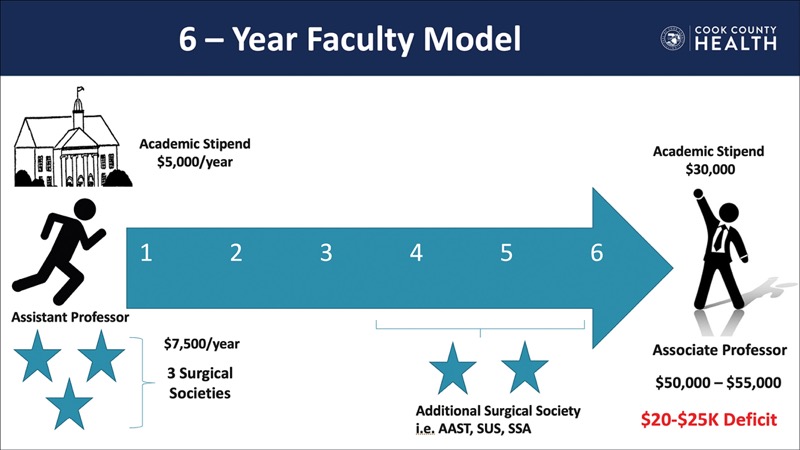
“When you do that math, adding in another society over six years, that’s going to be $50,000,” he said. “If you add two, it’s $55,000.”
More math: Most academic surgeons receive a stipend of $5,000 per year for continuing medical education (CME). Multiplied by six years, that’s $30,000 of institutional investment—$20,000 to $25,000 less than the average cost of belonging to and participating in these societies.
“That’s a deficit that the faculty member or department share,” Dr. Williams said. “It’s a considerable underinvestment that poses a challenge that needs to be looked at a little more closely.”
Dr. Williams noted that the cost estimates he provided are quite conservative and do not account for other costs associated with meeting attendance, such as bringing family members to meetings or covering child care or elder care. He also pointed out that although the study was conducted during a period of high inflation in the United States, “the cost increases I showed increased higher than inflation.”
Brian Daley, MD, MBA, of Knoxville, Tenn., questioned whether society membership is in fact a cornerstone of faculty advancement, believing personally that this is not true. “Rather, the elements of scholarly activity, research and service drive promotion, and society entrÉe only reinforces and vets the decision of the promotion committee.
“How many society memberships qualify someone for a promotion? Much of the manuscript and the presentation describes dollars spent. Is the purpose of this study to ask the deans for more money? Are the authors suggesting meeting costs are too high?”
The real question he thought the investigators were asking is what the value is in society membership, he said.
During his 24 years of independent practice, Dr. Daley often paid out of his own pocket to attend meetings and for society memberships without departmental reimbursement, and he used practice dollars to supplement the surgery department’s residents and fellows by endowing travel scholarships. He chose which organizations to join based on whether they provided the fellowship he sought.

“Not just ‘fellowship’ with a little ‘f,’ a friendly association with people who share one’s interests, but fellowship with a big ‘F,’ supporting members through coaching, mentoring, and sponsoring those individuals without concern for regard or reward,” Dr. Daley said. “I believe the Southeastern espouses those values, and that those rewards are unmeasurable and beyond any cost as we have heard today.”
Michael Sutherland, MD, MBA, a clinical associate professor of surgery at Northwestern Medicine, in Chicago, and the senior vice president of member services for the American College of Surgeons, noted that 75% of surgeons in the United States are now employed, working for hospitals, for-profit entities and venture capital firms that decide what the employers are willing to spend, leaving the balance to be paid by the surgeon.
“When we were in environments where we were making those decisions on our own, we were using pre-tax dollars out of our personal practices. So, the inflation mentioned is not just the cost associated with these events, but the 50% increase in total cost because we’re using after-tax dollars,” he noted.
“As organizations, we need to show our medical students and residents what can be gained from the big ‘F’ and little ‘f’ fellowship of being involved in organizations like the Southeastern, the ACS and our many subspecialty organizations,” Dr. Sutherland said.
John Sweeney, MD, the Joseph Brown Whitehead Professor and chair of surgery at Emory School of Medicine, in Atlanta, observed that at his institution, the service track—that is, membership and participation in regional and national organizations—is one of the three main paths to promotion.
“In order to be promoted, you have to demonstrate a track record. This investment is critical for the advancement of our faculty. But the administrators who look at our finances will push us to be more cost-efficient. We need to show them that faculty presence at these meetings may be the most cost-efficient form of marketing possible in terms of highlighting your accomplishments in front of a group, and being published in a rigorous peer-reviewed journal with potential press releases about your work,” he said.
Dr. Williams expressed gratitude to the Southeastern Surgical Congress for the discussion of the data, and told General Surgery News he appreciated both the mutuality and dichotomy of the views presented.
“We’re willing to talk about almost everything else in the surgical literature except this aspect of faculty development. It points to this almost sacrificial nature we have—what we’re willing to do for our patients and organizations without thinking twice—but it’s really important for us to discuss and acknowledge.”
Open discussion, he said, might generate ideas for a better approach than the current model of surgeons self-subsidizing society membership and participation, sometimes at considerable cost. For example, “we can take our salary, put it into academic development accounts pre-tax, which might be strategically better for individuals who wish to take that route.
“This data gives us an opportunity to think about how institutions invest in their faculty’s academic careers that may be more cost-sensitive to the individual,” Dr. Williams noted.