
Coming back from time off is the worst of all.
You finally get to the point where stress is leaving your neck and shoulders and you are starting to sleep without pain. You finally don’t feel like snapping at your family. The complications seem distant, and the guilt and fear have receded into the shadows. If you get to take two weeks off, you start to remember what it feels like to be normal.
But then you get on that plane, and you know that you’re heading back. Your neck starts to tense, and you look at your phone with anticipation and anger. You call to get checkout, and immediately it’s like you never left. Then, Monday morning, you have to step back into the arena, a gladiator in a contest with no end.
The arena was where you used to prove yourself. You would pit yourself against death. You were proud of the tough cases. These may have been cases others didn’t want to take on or were truly lost causes. Families always wanted you to do everything, and sometimes you knew that doing nothing was the best choice, but you would take that patient to the arena and see if you could win again—one more time to test yourself against fate.
Blood is spilled in the arena, but your job was to make sure it wasn’t too much or too often. The arena, especially in private practice, is a lonely place. You once gloried in that solitude. You were “the one in the arena,” but lately it’s lost some of its luster. Every time you walk through that door, instead of laurels, you see defeat lurking in every corner. You know that that day could be the day blood is spilled onto the sand.
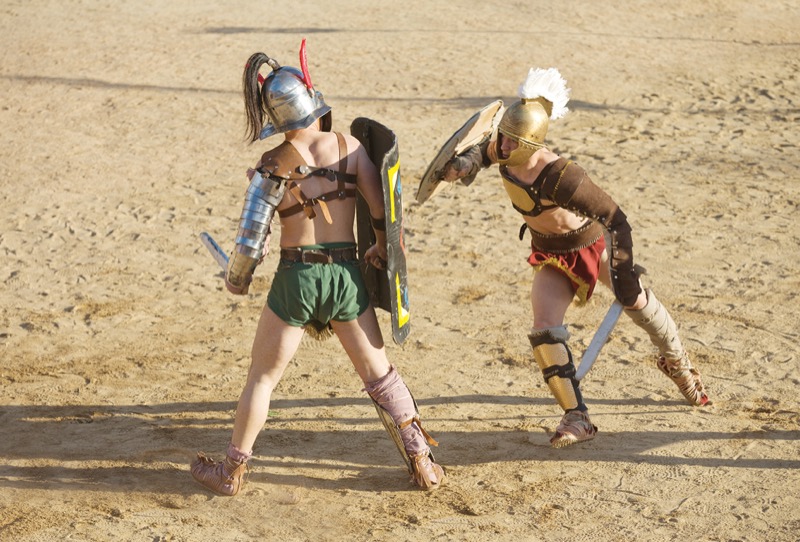
You wince when the blood flashes into the field. You know this could go a multitude of ways: from easy to control, to holding back terror while you try to staunch it. It never really changed as you got older—from when you could reach in and put your fingers on it to stop it, to later, to when you used rudimentary instruments to grasp in lieu of our hands, and still later to a robotic facsimile of the end effector of our brains. It still came down to control. Control of yourself first—then the bleeding.
A surgeon who is unable to control himself is more than useless—he is an actual danger. But as you get older, an interesting thing happens. It becomes easier to control the intraabdominal environment than to control your emotions. As you age, you develop an unwanted prescience. Before, you could easily see the path ahead, the path to a good outcome. You were aware of other paths, paths that lead to unwanted outcomes or even disaster. As you age, those other paths are more numerous and crowd into your vision, distracting you from the one safe way forward. You become the gladiator, the one in the arena. You’ve won thus far; you’ve lived to fight and fight again. But you know that at some point, at some time, you will lose. The blood on the sand of that arena will not be yours.
But today was a good day. No blood on the sand. Death was kept at bay once more, another draw in the game that we will all eventually lose. The resident says, “That was a good case,” not understanding yet that any case in which the patient lives is a great case. And once you are back into the swing of things, in that rhythm of case after case, it becomes easier to step into the arena, take the blade into your hands and grapple against fate. You might still have that little voice in your head that you’re just buying time, but you win, and you think that bad outcomes don’t happen to you.
But step away from the arena and you once again realize what an unnatural life you live. To delve inside people, cutting and healing, while they’re suspended near death. That bag of flesh and bone and viscera that you have invaded and tinkered with—the audacity! The self-doubt starts to return the farther you’re away from it. All the wisdom that you’ve accumulated, the battle-learned lessons of caution and consideration, the incredible accumulation of technical skill don’t seem to be enough.
But you know you must step back into the arena. I would recommend talking to others who face the blood on the sand. They are the only ones who can truly understand. Someday, I will retire my scalpel. Until then my brothers and sisters, you who are the ones in the arena. I salute you.
Dr. Clapp is a bariatric and general surgeon from El Paso, Texas.